Renovate Before Move-in — Complete Guide
Buying a home in Austin often means buying a project, and the smartest time to tackle that project is before the boxes arrive. When you renovate before move-in, you avoid living through dust and demolition, you compress the timeline, and you make decisions with resale value in mind from day one. This guide walks you through why an empty house is the best jobsite, how to budget and sequence the work, and which projects deserve priority before your furniture shows up. Along the way, you'll see how a broker-led team that handles both the home and the transaction changes the math on every decision.
What You'll Find in This Guide
Coming soon — we're building out this topic cluster.
Why It Pays to Renovate Before Move-In
An empty house is the cheapest, fastest place to run a renovation. Crews move freely, floors go in wall to wall without furniture shuffling, and paint dries without anyone breathing fumes at the dinner table. As a result, projects that take three months in an occupied home often finish in six weeks when nobody lives there.
Speed is only part of the story. Because the work happens before you settle in, you make design choices with a clear head instead of reacting to daily annoyances. For example, you can open a kitchen wall, replace flooring throughout, and repaint every room in one coordinated pass. Doing those same projects one at a time over five years costs more, disrupts more, and rarely produces a cohesive result.
The Timing Advantage in the Austin Market
Timing matters more in Austin than in most metros. Many buyers here purchase older homes in central neighborhoods precisely because they plan to update them. However, the window between closing and move-in is where most people lose momentum. They close, move in "temporarily," and then live with the avocado bathroom for a decade.
Temporary housing used to be the sticking point. That has eased considerably. According to Apartment List, average rent for a two-bedroom in the Austin area fell from a peak of $1,725 in August 2022 to $1,382 by October 2025, while vacancy rates surged from 3.96% to 9.71%. In practice, that means finding a short-term rental for six or eight weeks is easier and cheaper than it has been in years. Bridging one extra month of rent often costs far less than the premium contractors charge to work around an occupied home.
Health and Safety Considerations
Beyond convenience, there are real health reasons to finish before move-in. If your new home was built before 1978, renovation can disturb lead-based paint, and federal rules require lead-safe work practices. The EPA's Renovate Right program explains what certified contractors must do to protect occupants. With no occupants in the house, containment is simpler and safer. The same logic applies to floor refinishing fumes, drywall dust, and any project that touches old insulation.
Budgeting and Sequencing a Pre-Move-In Renovation
Most renovation regret traces back to two mistakes: spending without a resale ceiling in mind, and sequencing trades in the wrong order. Fortunately, both are avoidable with a plan built before demo day. When you decide to renovate before move-in, careful budgeting and sequencing become your foundation for success.
Set a Budget Tied to Value, Not Just Wishes
Start with what the finished home should be worth, then work backward. This is where a broker-led approach differs from hiring a contractor alone. A contractor prices the work. A broker who renovates prices the work against what Austin buyers actually pay for, so you know whether a $90,000 kitchen makes sense in a neighborhood where the ceiling is $650,000. To put it simply, every dollar should either improve your daily life or your eventual sale price, and ideally both.
Carrying costs deserve equal attention. Unlock MLS's Homeowner Affordability Index found that every additional $100 a month in carrying costs pushes an estimated 9,800 Central Texas households into financial strain. Consequently, if you finance the renovation, model the monthly payment before you sign anything. A project that stretches your payment past comfort is a project that needs a smaller scope.
Sequence the Work Like a General Contractor
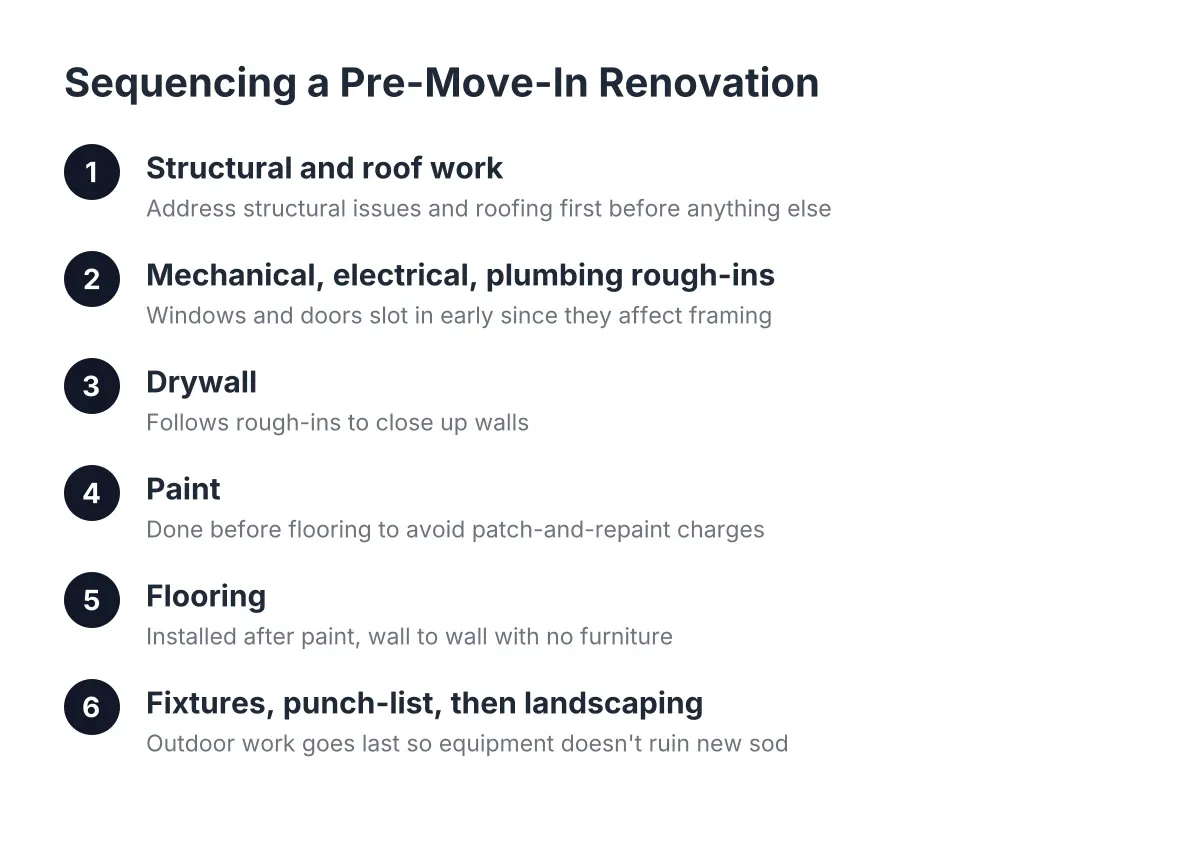
Order matters as much as budget. In practice, a pre-move-in renovation should flow roughly like this: structural and roof work first, then mechanical, electrical, and plumbing rough-ins, then drywall, then paint, then flooring, then fixtures and punch-list items. Windows and doors slot in early because they affect framing and weatherproofing. Landscaping and outdoor living come last so heavy equipment doesn't destroy new sod.
Why does this matter to you? Because a scattered sequence creates redo work. For example, installing new hardwood before the kitchen remodel means crews roll appliances across your fresh floors. Similarly, painting before electrical work guarantees patch-and-repaint charges later. A single project manager coordinating one subcontractor network keeps the sequence tight. That coordination is the difference between a six-week timeline and a four-month one.
Build a contingency of 10 to 15 percent into the budget. Older Austin homes hide surprises behind walls, from cast iron plumbing to undersized panels. With a contingency in place, a surprise becomes a line item instead of a crisis.
Which Projects to Tackle Before Move-In (and Which Can Wait)
Not everything belongs in the pre-move-in scope. The goal is to finish the projects that are miserable to live through, protect the ones that affect resale, and defer the ones you can do comfortably later.
Do These Before the Furniture Arrives
Flooring tops the list. Replacing carpet or refinishing hardwood in an empty house costs less and finishes faster than doing it room by room later. Interior painting comes next for the same reason, since painters work twice as fast without furniture to mask and move.
Kitchens and bathrooms follow closely. A kitchen remodel in an occupied home means weeks of microwave dinners and a refrigerator in the living room. Similarly, a bathroom remodel with only one bathroom in the house is genuinely unlivable. If either space needs a full gut, do it now. Additionally, any project that opens walls, such as rewiring, repiping, or removing a wall to open the floor plan, belongs firmly in the before category. Roof repairs and window replacement also qualify, because water intrusion damages everything you're about to install.
These Can Reasonably Wait
Exterior painting, decks, patios, and landscaping disrupt daily life far less, so they can happen after you settle in. The same goes for a home addition or an ADU conversion, since crews can often isolate that work from the living space. However, if you already know you'll add a second story or convert the garage, get the plans and permits moving now. Permitting timelines in the Austin metro can run months, and starting the paperwork early means the build starts sooner.
Interior design decisions should happen early either way. Even if some projects wait, choosing finishes, colors, and layouts as one cohesive plan prevents the patchwork look that comes from deciding room by room. That said, before you renovate and move in, a design consultation before closing is even better, because it tells you what the house can become before you commit to it.
Think Ahead to the Day You Sell
Every choice you make now becomes a selling point or a repair item later. With this in mind, prioritize improvements that Austin buyers consistently reward: updated kitchens, refreshed bathrooms, durable flooring, and sound mechanical systems. Buyers are older and more selective than they used to be. NAR's 2025 Profile of Home Buyers and Sellers found the median first-time buyer age reached a record 40 years old, and first-time buyers dropped to a historic low of 21% of the market. Older, repeat buyers scrutinize condition. A home renovated with resale in mind holds up under that scrutiny.
Frequently Asked Questions
What is the 30% rule for renovations?
The 30% rule suggests you should spend no more than 30% of your home's current market value on a renovation. For example, on a $500,000 Austin home, that caps the project around $150,000. It's a guardrail against over-improving beyond what your neighborhood supports, not a strict law. In practical terms, the rule keeps your total investment aligned with resale value. If purchase price plus renovation cost pushes well past comparable sales nearby, you may struggle to recover the money at sale. A broker-led team can pull actual neighborhood comps so you're working from real numbers instead of a rule of thumb.
How much does it cost to renovate a home before moving in Georgetown, TX?
Costs in Georgetown vary widely with scope. Cosmetic updates like paint and flooring often run in the tens of thousands, while a whole-house renovation with kitchen and bath remodels can reach six figures. Because labor and material prices shift, get a scoped estimate tied to your specific home rather than relying on per-square-foot averages.
What is the 30% rule in remodeling?
Think of it as a budgeting ceiling rather than a target. Many successful pre-move-in renovations spend far less than 30% of home value, especially when work focuses on high-impact items like flooring, paint, and kitchen or bath updates. The rule also helps you compare properties before purchase—if a home needs work exceeding 30% of its value, you're closer to a rebuild than a renovation, and the price should reflect that. Local market knowledge matters more than the percentage itself.
Ready to Get Started?
If you're closing on a home in the Austin metro and want it truly ready before the movers arrive, we can walk the property with you, scope the work, and manage every trade through our own subcontractor network. Because we handle the home and the transaction, every recommendation is priced with your future resale in mind. Reach out and let's plan your renovation before the boxes do the talking.