Metal vs. Asphalt Roofing in Austin: Durability, Cost, and What Buyers Actually Pay For
If you are weighing a new roof in Austin, the real question is not which material wins a spec-sheet contest. It is how metal asphalt roofing durability plays out against your actual situation: an aging roof an inspector will flag, a hail season that keeps getting meaner, and a resale market where buyers read the inspection report before they read the listing description. This guide walks through both materials the way we talk about them with homeowners across the Austin metro, whether you are staying put for another fifteen years or getting a home sell-ready in the next six months. Understanding how your roof choice affects metal roof resale value will help you decide whether durability or cost should drive your decision.
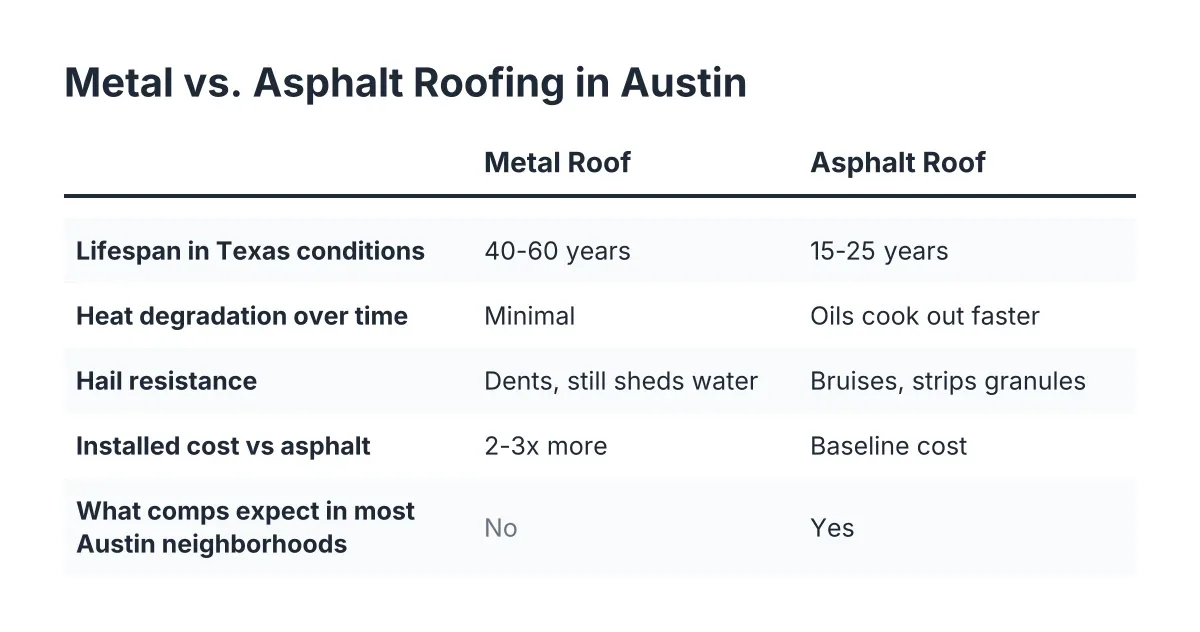
Here is the short version up front. Metal lasts longer and shrugs off more weather, but it costs two to three times as much installed. Asphalt is cheaper and faster, and in most Austin neighborhoods it is what the comps expect. Which one makes sense depends on your timeline, your roof's geometry, and whether a sale is in your future. The rest of this article unpacks why.
Why the Roof Decision Usually Starts With an Inspection, Not a Leak
Most Austin homeowners do not wake up wanting a new roof. The decision arrives one of two ways. Either something fails, a leak after a spring storm, granules filling the gutters, a ceiling stain that was not there last month. Or an inspector finds the problem for you.
The second path matters more than most people realize. In a home sale, the roof is one of the first things a buyer's inspector climbs on, and it is one of the few line items that can stall a deal on its own. Lenders and insurers care about roof condition. A roof near the end of its life can trigger an insurance surcharge for the buyer, a repair credit demand, or a renegotiation at exactly the moment a seller has the least leverage.
Therefore, if you plan to list within the next one to six months, treat your roof as a transaction item, not just a maintenance item. A roof inspection before selling, done on your schedule rather than the buyer's, lets you decide between repair, replacement, or a priced-in credit while you still control the timeline. We see this constantly in pre-listing prep across the Austin metro: the sellers who address the roof before photos go up negotiate from strength, and the ones who wait negotiate under deadline.
For the homeowner who is not selling, the stakes are different but the logic is the same. A roof decision made calmly, with time to compare materials and bids, beats one made with a tarp on the house.
Signs You Need a New Roof Versus a Repair
A roof needs full replacement when the damage is widespread or the material has aged out; it needs repair when the problem is isolated and the surrounding roof still has life. In Austin, most repair-versus-replace calls come down to the age of the shingles, the pattern of the damage, and what hail has done over multiple seasons.
Look for these replacement signals:
- Shingles that are curling, cupping, or losing granules across large sections, not just one slope
- An asphalt roof past 15 to 18 years in Central Texas sun, even if it looks acceptable from the street
- Multiple leaks in different areas, which usually means the system is failing, not a single flashing point
- Hail bruising across several slopes after a storm, which insurers often treat as total-roof damage
- Daylight visible in the attic, or decking that feels soft underfoot
By contrast, these usually point to roof repair:
- A leak isolated to one penetration, such as a vent pipe, chimney, or skylight flashing
- Wind damage limited to a handful of shingles on one slope
- A roof under 10 years old with an otherwise clean inspection
As an illustrative range, minor roof repair cost in the Austin market tends to run a few hundred dollars for flashing or a small shingle patch, up to $1,500 to $3,000 for larger sectional work. Those are estimates, not quotes; steep pitches, tile, and second-story access all push the number up. The trap to avoid is serial repair: if you are paying for the third patch in two years on an 18-year-old roof, you are financing a replacement one leak at a time.
One honest caveat here. Hail damage is hard to self-diagnose from the ground, and so is decking condition. If your roof is past 12 years old or has been through a significant hail event, get a professional inspection before deciding anything. An inspector or an experienced roofer can tell you whether damage is cosmetic or structural, and that distinction drives both the insurance conversation and the repair-versus-replace call.
Metal vs. Asphalt: How Roof Durability Affects Resale Value in Central Texas
On pure durability, metal beats asphalt, and it is not close. A quality standing-seam metal roof routinely lasts 40 to 60 years in Texas conditions, while architectural asphalt shingles in Central Texas heat realistically deliver 15 to 25 years, often toward the lower end on west-facing slopes. The gap comes from how each material handles the three things Austin throws at a roof: heat, hail, and wind.
Heat is the quiet killer. Austin summers bake asphalt shingles, cooking out the oils that keep them flexible. That is why a shingle rated for 30 years up north ages faster here. Metal does not degrade the same way; it expands and contracts, which is why proper installation with the right fastening system matters, but the material itself is not breaking down in the sun.
Hail is more complicated, and this is where the durability conversation gets honest. Large hail dents metal. The roof usually keeps shedding water, so the damage is cosmetic, but a field of dents on a standing-seam roof is visible, and some insurance policies exclude cosmetic metal damage. Asphalt handles small hail adequately, but larger stones bruise the mat and strip granules, which shortens the roof's life even when nothing leaks immediately. In a bad hail year, asphalt roofs get replaced and metal roofs get dented. Which outcome you prefer depends on who is paying.
Wind favors metal as well. Standing-seam panels are mechanically locked and rated for high wind speeds, while asphalt shingles rely on adhesive strips that weaken with age. The shingles that blow off in an April storm are usually the old ones, which is one more way age and durability compound each other.
So the metal asphalt roofing durability comparison, stated plainly: metal is the longer, tougher asset. The question is whether you will own the house long enough to collect on that durability, which brings us to cost.
What Each Roof Costs in the Austin Metro, and What the Durability Buys You
Installed cost is where asphalt wins. As a general 2026 estimate for the Austin metro, architectural asphalt shingles tend to run in the range of $4.50 to $7.50 per square foot installed, while standing-seam metal commonly lands between $10 and $16 per square foot. On a typical 2,200-square-foot single-story home with about 2,600 square feet of roof area, that is roughly $12,000 to $19,000 for asphalt versus $26,000 to $42,000 for metal. These are illustrative ranges, not bids; the only number that matters for your house comes from a walkthrough and a written estimate.
Several variables move those numbers more than material choice alone:
- Pitch and complexity. A steep roof with multiple valleys, dormers, and penetrations costs more in labor and waste. A roof pitch calculator can give you the rise-over-run, but the practical point is that anything above a 6/12 pitch slows the crew and raises the price.
- Actual roof area. Your roof is larger than your floor plan. A roof square footage calculator that accounts for pitch gets you close, but estimators measure the real planes, including overhangs.
- Decking condition. If the plywood underneath is rotted or delaminated, replacement sheets get added during tear-off. Nobody can price this precisely until the old roof comes up, which is why a good estimate includes a per-sheet decking allowance in writing.
- Tear-off layers. A second layer of old shingles underneath adds disposal cost and labor.
Now the durability math. Spread over its life, metal can pencil out: one 50-year roof instead of two or three asphalt roofs, plus lower odds of storm-driven replacement. Metal also reflects heat, which helps summer cooling bills in a climate where that is not a small line item. However, that math only works if you stay long enough to amortize it, or if your buyer pool pays for it. Which, in most of Austin, they do not, at least not dollar for dollar.
How Long Does a Roof Replacement Take?
A straightforward asphalt roof replacement on a typical Austin single-family home takes one to three days once the crew starts, assuming clear weather and sound decking. Standing-seam metal takes longer, commonly four days to a week or more, because panels are often fabricated to length and the installation is more exacting.
The on-roof days are the short part. The full timeline, from signed estimate to final walkthrough, runs longer: material ordering, permit handling where required, and scheduling around weather all add lead time. Asphalt shingles are stocked locally and can often start within a couple of weeks. Metal panels in a specific color or profile may carry several weeks of lead time before a crew ever shows up.
This is where the pre-listing seller needs to pay attention. Suppose a homeowner in Travis Heights plans to list in eight weeks and the pre-inspection flags a 19-year-old roof with hail bruising on two slopes. In that scenario, asphalt fits the window comfortably: order materials, tear off and replace in two or three days, and the listing goes live with a transferable new-roof story instead of an inspection liability. Metal, with its fabrication lead time and higher cost, likely does not fit the window and would not return its premium at that price point anyway. Timeline is a material-selection criterion, not just a scheduling detail.
For the homeowner staying put, the calendar pressure is lighter, but sequencing still matters. If a roof replacement is part of a larger renovation, the roof goes on before interior finish work, and ideally before any addition framing is buttoned up, so one managed project covers the flashing and tie-ins instead of two contractors pointing at each other later.
Understanding Metal Roof Resale Value in Austin's Market
A metal roof rarely returns its full cost premium at sale in most Austin neighborhoods, while a new asphalt roof usually protects the sale price by removing an inspection objection. Durability is worth real money to the person who lives under the roof for decades; the buyer at your open house is mostly paying for "no roof problem."
Think about what a buyer and their inspector actually evaluate. A five-year-old asphalt roof and a five-year-old metal roof both pass inspection clean. Both keep the insurance quote reasonable. Both let the deal move. The metal roof cost the seller $15,000 to $25,000 more, and the appraisal rarely captures that gap, because appraisers work from comps, and most comps in Hyde Park, Crestview, or Pflugerville have asphalt shingles. When assessing metal roof resale value, remember that the market price depends more on what comparable homes have than on the superior longevity that metal offers.
There are exceptions worth naming. In parts of Westlake, Tarrytown, and the Hill Country edges like Dripping Springs, standing-seam metal is an expected design element on modern and higher-end homes, and the market there does reward it. On an architect-designed home in Zilker or a new modern build in East Austin, asphalt can read as a value-engineering shortcut. Material choice should match what buyers in your specific pocket of the market expect, which is a conversation about comps, not catalogs.
The market context sharpens this. Austin pricing has been uneven; LRG Realty reported the median home value dipped 2.3% to $429,869 in Q1 2025 as inventory climbed and homes sat longer, while Redfin data showed the median sale price at $476,800 in Q3 2025, up 3.4% year over year. By July 2026, KXAN reported the metro median at $435,000, up 1.0% year over year. The pattern underneath those numbers: buyers have options and time. In that market, a flagged roof gives them a reason to keep shopping or to ask for a steep credit. Removing the objection is the return. Chasing a premium for over-building the roof usually is not.
So the resale logic sorts into three honest lanes:
- Selling within a year, mid-market home: a new architectural asphalt roof, or documented repairs with a clean inspection letter, is almost always the right-sized move.
- Staying 15-plus years: metal's durability, energy performance, and one-and-done appeal deserve a serious look, because you are the one collecting the long-term value.
- High-end or design-driven home: let the neighborhood comps and the home's architecture pick the material, and get advice from someone who knows what buyers in that pocket pay for.
Making the Call: A Practical Sequence for Either Homeowner
Whether you are the seller prepping to list or the homeowner who has postponed this decision through three storm seasons, the sequence is the same. The difference is the deadline.
First, get the roof inspected before anyone forces the issue. For sellers, that means a pre-listing roof inspection so the repair list is yours to manage. For long-term owners, it means an honest condition report before the next leak chooses the timing for you.
Next, sort the findings into repair, replace, or monitor. Isolated flashing failures and a few wind-lifted shingles are repairs. Widespread granule loss, multi-slope hail bruising, or an asphalt roof pushing 18 years in Texas sun points to replacement. The serial-patch trap is real; add up what you have spent on repairs in the last three years before approving another one.
Then match the material to your timeline and your comps. The metal asphalt roofing durability gap is real, but it only pays the owner who stays, or the seller whose neighborhood expects metal. For most Austin metro homes heading to market, quality architectural asphalt, installed well and documented, does the job.
Finally, insist on one accountable point of contact and a written scope. This matters double if you have been burned by a contractor before. The scope should name the material, the underlayment, the decking allowance, the flashing details, the tear-off and disposal, and the schedule. Wildly different quotes usually mean wildly different scopes, not wildly different honesty; a line-item estimate lets you compare bids on the same terms. A managed project with a defined walkthrough at the end is how a roof gets done once, on the promised timeline, instead of becoming the next stalled renovation story.
The roof over your head is either a durable asset or a pending objection. Decide which one it is on your own schedule, with the material that fits your actual future in the house, and the rest of the decision gets simple.
If you need pre-listing home renovation, Lujo Realty can help.
Prefer to talk it through? Call Lujo Realty — a quick call is usually the fastest way to get a straight answer for your situation.