How Much Does Patio Installation Cost in Austin? Materials, Labor, and Design Choices
How much does patio installation cost in Austin? For most homes in the Austin metro, a professionally installed patio runs somewhere between $15 and $50 per square foot as of 2026, depending on material, site conditions, and how much design you layer on top. A simple poured-concrete pad on a flat lot sits at the low end. A paver patio with a seating wall, drainage work, and a cover can push well past the high end. Those are illustrative ranges, not quotes; the only number that matters is the one on a written estimate for your specific yard.
This guide breaks down where the money actually goes: materials, labor, site prep, and the design choices that quietly double a budget. It is written for the homeowner who has already decided to build, maybe after years of putting it off, and wants to get it done once, on schedule, with a space that holds its value when Austin buyers eventually walk the backyard.
That resale lens matters more than most patio guides admit. We buy, sell, and renovate homes across the Austin metro, and we price outdoor work with an eye on what buyers in neighborhoods like Zilker, Travis Heights, and Westlake actually pay a premium for. A patio is one of the few outdoor projects that works at both ends: you use it for years, and it photographs well on listing day.
What Drives Patio Installation Costs in Austin
Patio installation cost comes down to four things: the material you choose, the labor and equipment to install it, the condition of your site, and the extras you add on top of the slab or pavers. Material usually gets the attention, but in Central Texas, site conditions and labor often move the total more than the surface you pick.
Start with square footage, because everything scales from it. A 12-by-16 patio is 192 square feet, which is tight for a dining table and a grill. Most Austin homeowners building a patio they will actually live on land between 250 and 400 square feet. At an illustrative $25 per square foot installed, that is roughly $6,000 to $10,000 before covers, kitchens, or fire features.
Next comes the ground under the patio. Much of Austin sits on expansive clay soil that swells when wet and shrinks in drought. A patio built on poorly compacted clay will heave, crack, or settle unevenly within a few seasons. Proper base preparation, meaning excavation, compacted gravel, and correct slope for drainage, is the least glamorous line on the estimate and the one you should never let a bidder cut. Understanding what affects patio installation cost in Austin requires attention to these soil and drainage factors.
Finally, access affects labor. A crew that can back a skid steer into your yard works faster than one hauling gravel by wheelbarrow through a 36-inch gate. If you own an older home in Hyde Park with a narrow side yard and mature trees, expect the labor line to reflect that. It is not padding; it is hours.
How Patio Installation Cost, Materials, and Labor Factor Into Austin Projects
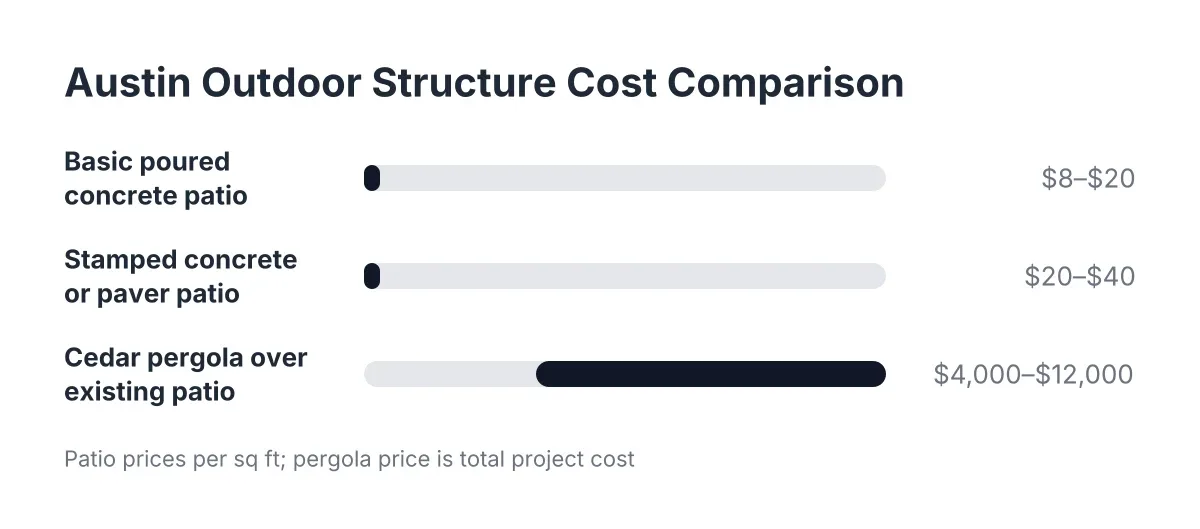
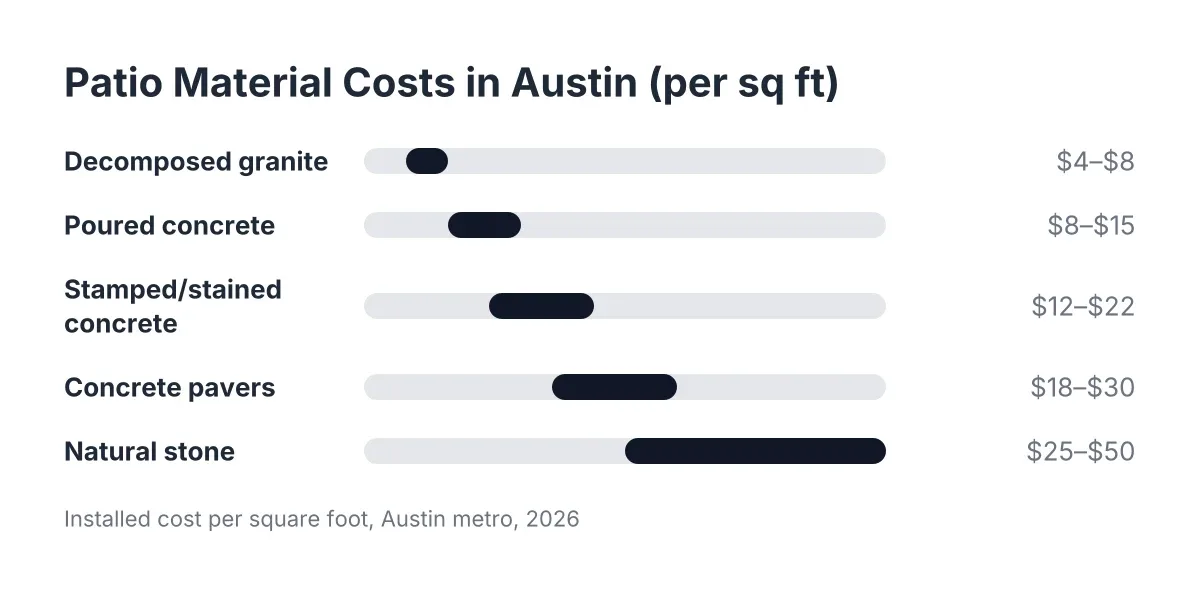
Material is the first fork in the road, and the price spread is wide. Here is how the common options tend to compare in the Austin market as of 2026, using installed per-square-foot estimates. Treat these as planning ranges, not quotes.
- Poured concrete: roughly $8 to $15 per square foot installed. The budget workhorse. Durable, fast to install, and fine for a clean, modern look. The risk in our clay soil is cracking, so control joints and a proper base matter.
- Stamped or stained concrete: roughly $12 to $22 per square foot. Adds texture and color without the cost of stone. Stamped patterns date faster than plain finishes, which matters if you plan to sell within a decade.
- Concrete pavers: roughly $18 to $30 per square foot. The sweet spot for many Austin backyards. Individual pavers flex with soil movement instead of cracking, and a damaged unit can be swapped without redoing the patio. If you are wondering how much paver installation costs per square foot beyond that range, upgrades like permeable pavers or intricate patterns push toward $35.
- Natural stone (limestone, travertine, flagstone): roughly $25 to $50 per square foot. Lueders limestone reads as native to Central Texas and suits homes in Tarrytown or Westlake where buyers expect finish quality. Travertine stays cooler underfoot in August, which is not a small thing here.
- Decomposed granite: roughly $4 to $8 per square foot. Not a true patio surface, but a useful budget extension for paths and secondary seating areas around the main slab.
One honest trade-off: pavers cost more upfront than poured concrete, but they handle Austin's soil movement better over ten years. If this is your long-term home, that durability argument carries weight. If you are preparing to list within a year or two, a well-finished concrete patio often delivers the backyard photo without the paver premium.
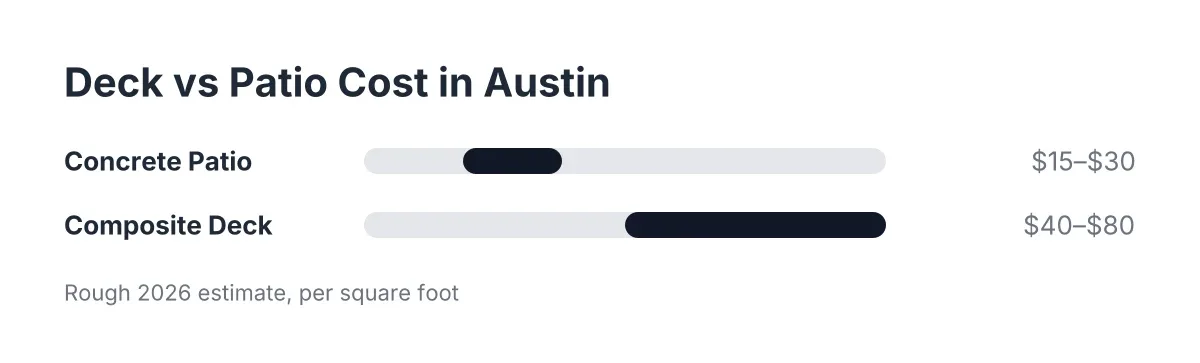
A note on the deck versus patio cost question, since it comes up in nearly every walkthrough. A ground-level patio is usually cheaper per square foot than a wood or composite deck, which needs framing, footings, and ongoing maintenance. Decks earn their cost on sloped lots or where the back door sits well above grade, which is common in hillier pockets like Lakeway and Bee Cave. On a flat East Austin lot, a patio typically wins on both cost and longevity. We cover deck construction costs in a separate guide.
Labor and Site Conditions in Austin Patio Installation
Labor typically accounts for 40 to 60 percent of a patio installation budget in Austin. On a $10,000 paver patio, expect $4,000 to $6,000 of that to cover excavation, base compaction, cutting, laying, and cleanup. Complex patterns, curves, steps, and retaining elements all add skilled hours, which is why two bids for the "same" patio can land thousands apart. The factors affecting patio installation cost in Austin include crew efficiency, site access, soil conditions, and the complexity of drainage requirements.
This is also where the wildly-different-quotes problem comes from, and if you have collected three bids that range from $7,000 to $18,000 for what sounds like the same project, you are not imagining things. The bids are usually not for the same project. One includes four inches of compacted road base, geotextile fabric, and polymeric sand; another assumes the existing grade is fine and skips the fabric. The cheap bid is cheap because of what is missing, and what is missing is exactly what fails first in clay soil.
Therefore, when you compare estimates, make every bidder itemize the same things:
- Demolition and haul-off: removing an old cracked slab or sod, and where the debris goes.
- Excavation depth and base material: how many inches of compacted gravel, and whether fabric is included.
- Drainage and slope: where water goes when it leaves the patio. In Austin's spring downpours, this is not optional.
- Surface material and pattern: exact paver or stone product, not "pavers, allowance."
- Edge restraint and joint treatment: what holds the perimeter in place and what fills the joints.
- Cleanup, sealing, and final grading: who restores the lawn the skid steer drove across.
In addition, ask who manages the job day to day. The single biggest complaint we hear from homeowners who got burned before is not price; it is the contractor who stopped showing up in week three. A managed project with one point of contact, a defined scope, and a subcontractor team that has worked together before is how you avoid the half-finished patio that sits as a gravel pit through a whole summer. That accountability is worth asking hard questions about before you sign anything, whoever you hire.
Design Choices That Move the Budget Most
Upgrades, not square footage, are where patio budgets double. The slab or paver field is the predictable part. The design layer on top is where a $9,000 project becomes a $35,000 outdoor room, so decide early which additions serve how you live and which are nice-to-haves.
A patio cover is the biggest single line. A basic attached cover or pergola might start around $3,000 to $6,000 installed, while a fully framed, roofed cover that matches the house, with electrical for fans and lighting, can run $10,000 to $25,000 or more. In Austin, shade is not decoration. A west-facing patio without cover is unusable from June through September, and buyers touring homes in August notice immediately which backyards they could actually sit in.
Beyond the cover, the common adders stack up fast. A gas fire pit with a surround might add $2,000 to $6,000. A built-in outdoor kitchen with a grill, counter, and utility runs starts around $8,000 and climbs quickly with stone veneer and appliances. Low-voltage landscape lighting, $1,500 to $4,000, is one of the highest-impact, lowest-cost additions for both evening use and listing photos.
Landscaping around the patio deserves its own line in the budget, usually 10 to 20 percent of the hardscape cost. A new patio floating in a tired lawn looks unfinished. Native and drought-tolerant planting, the xeriscaping approach that fits Austin's watering restrictions, frames the space and cuts maintenance. For sellers, fresh landscaping before listing is among the cheapest curb-appeal moves available; for stayers, it is what makes the patio feel like a destination rather than a slab.
For example, suppose a homeowner in Travis Heights has a 1960s ranch with a cracked 10-by-12 concrete pad off the kitchen. Say the plan is demolition, a 320-square-foot paver patio, a cedar pergola over half of it, lighting, and planting beds along two sides. In that scenario, an illustrative all-in budget lands around $22,000 to $30,000: roughly $8,000 to $10,000 for the paver field and base work, $6,000 to $9,000 for the pergola and electrical, $2,000 for lighting, demolition and haul-off, and the balance in landscaping. The same homeowner could cut that to about $14,000 by choosing broom-finished concrete and a shade sail, and the backyard would still function. Neither answer is wrong; they are different bets on how long you will own the house.
Pricing a Patio With Resale in Mind
Build the patio for how you live, but spend where Austin buyers reward it. The market data makes the case for discipline. The median sales price for the Austin metro was $435,000 as of July 2026, up 1.0% year-over-year, according to KXAN. Meanwhile, LRG Realty reported Austin's median home value dropped 2.3% to $429,869 in Q1 2025 as inventory climbed and homes sat longer before selling. In a market where homes compete harder for buyers, finished outdoor living spaces help a listing stand out; over-improved ones rarely earn their cost back.
As a result, the resale-smart rules are simple. First, match the patio's finish level to the house and the street. A $45,000 travertine outdoor kitchen behind a $420,000 home in Pflugerville will not return its cost; the same budget behind a Westlake home might be the expected standard. Second, prioritize shade, lighting, and drainage over luxury surfaces, because those three determine whether the space is usable, and usability is what buyers respond to in showings. Third, keep the design neutral. A built-in fire feature in local limestone ages well; a heavily themed outdoor bar narrows your buyer pool.
However, if a sale is on the calendar, flip the calculation. Skip the full rebuild and put a smaller number into pre-listing prep: pressure washing, re-sanding paver joints, repairing cracked sections, refreshing mulch and plantings, and adding lighting. Sell-ready is a different standard than live-here-for-fifteen-years, and spending like a seller when you are selling is how you protect your margin. This is where working with a broker-led team changes the math, because the people pricing the renovation scope are the same people who will price the listing.
What the Patio Installation Process Looks Like, Step by Step
You have chosen to build. Here is the sequence a well-run patio project in the Austin metro follows, so you can hold whoever you hire to it.
- Walkthrough and scope. Someone stands in your yard, measures, checks grade and drainage, and asks how you will use the space. An estimate produced without a site visit is a guess.
- Written estimate with itemized scope. Materials by name, base depth, drainage plan, timeline, and payment schedule. Progress payments tied to milestones protect you; large upfront deposits do not.
- Design and material selection. Lay out furniture dimensions on paper before finalizing size. A patio that is two feet too small for the dining set is a permanent irritation.
- Utility locates and any permits. Covers with electrical, gas lines for fire features, and structures attached to the house can trigger permitting in Austin and surrounding cities. Confirm who pulls the permit before work starts.
- Demolition, excavation, and base. The invisible phase that determines whether the patio is still flat in 2036. Ask to see the compacted base before the surface goes down.
- Surface installation, edging, and joints. The fast, satisfying part, usually days rather than weeks once the base is right.
- Finish work and punch list. Sealing if specified, lighting, grading repair, planting, and a final walkthrough against the written scope.
For a straightforward paver patio, the on-site work often runs one to two weeks once materials arrive, weather permitting. Covers, kitchens, and permit reviews extend that. Get the timeline in writing with the estimate, and ask what happens to the schedule if rain or a material delay hits.
One limitation worth naming: if your yard has significant slope, poor drainage toward the foundation, large tree roots, or signs of soil movement in the existing hardscape, bring in a professional before you commit to a design. Fixing drainage after the patio is built costs multiples of fixing it first, and in some cases an engineer's input on grading is money well spent.
Getting a Real Number for Your Yard
So, how much does patio installation cost for your specific home? The planning ranges in this guide, roughly $8 to $15 per square foot for concrete and $18 to $50 for pavers and stone installed, will get your budget in the right neighborhood. The walkthrough gets you the real number, because your soil, access, slope, and design choices are what the estimate actually prices.
Before you sign with anyone, insist on three things: an itemized written scope, a named single point of contact who answers the phone during the job, and references for work in soil like yours. If you were burned by a contractor who disappeared mid-project before, those three requirements are your protection, and any team worth hiring will welcome them.
Across the Austin metro, from Hyde Park bungalows to new builds in Leander and Kyle, the patios that pay off share the same traits: honest base work, enough shade to use in summer, and a finish level that fits the house. Price the project with resale in mind even if you are staying, build it once, and the backyard stops being the project you have put off and becomes the room you use most from March through November.
If you need pre-listing home renovation, Lujo Realty can help.
Prefer to talk it through? Call Lujo Realty — a quick call is usually the fastest way to get a straight answer for your situation.