How Much Does Outdoor Deck Construction Cost?
How much does outdoor deck construction cost? The honest answer depends on three things more than anything else: the size and height of the deck, the material you choose for the decking surface, and how much site work your yard needs before a single board goes down. Anyone who hands you a firm number before seeing your lot is guessing. By the end of this guide you will know exactly what drives deck pricing in the Austin metro, and how to get a real estimate for your own project instead of a number invented for a web page.
What Drives the Cost of Outdoor Deck Construction
Deck pricing is not mysterious. It comes down to a handful of variables you can size up in your own backyard before you ever call anyone.
Square Footage and Height
Size is the biggest lever. More square feet means more framing lumber, more decking boards, more fasteners, and more labor hours. Height matters almost as much. A deck that sits close to grade needs simple footings and no railing in most cases. A deck off a second story in Westlake or Travis Heights needs engineered posts, deeper footings, stairs, and code-required railing on every open edge. Walk outside and look at your door threshold. If it sits more than a step or two above the yard, plan for the taller, more expensive version.
Decking Material
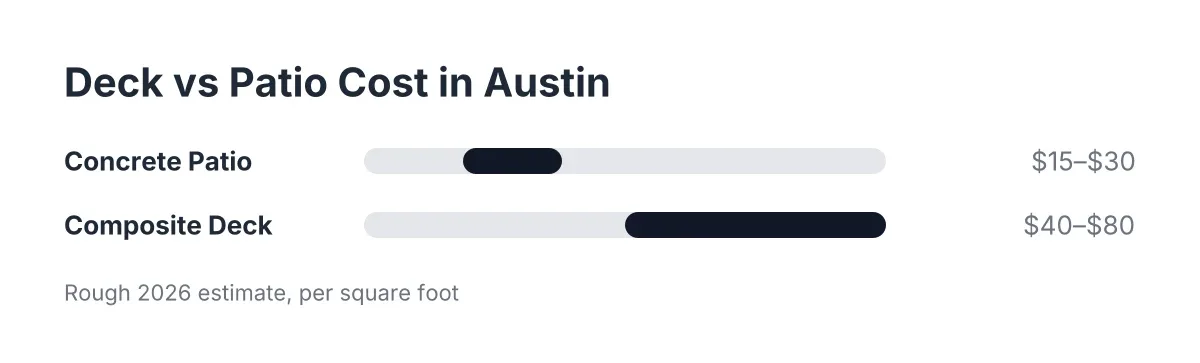
Pressure-treated pine sits at the low end of the material range. Cedar and other naturally rot-resistant woods cost more up front but handle Central Texas sun better. Composite and PVC decking cost the most per board, but they skip the sanding, staining, and sealing that wood demands every couple of years in our climate. The tradeoff is real: wood is cheaper on day one, composite is cheaper over a decade of Austin summers. Which side you land on depends on how long you plan to own the home. If you are prepping to sell, we price that decision with resale in mind, because Austin buyers notice a fresh deck and discount a tired one.
Site Conditions and Access
Flat, open backyard with truck access? The crew works fast and the price reflects it. Sloped lot in the hills west of town, limestone a few inches under the topsoil, or a gate too narrow for equipment? Every one of those adds labor. Rock is the quiet budget-killer in the Austin metro; drilling footings into limestone takes different tools and more time than digging into East Austin clay. If you can see exposed rock in your yard, mention it when you ask for an estimate.
Design Complexity
A simple rectangle is the cheapest shape in construction. Multiple levels, angled corners, built-in benches, planter boxes, pergolas, and wraparound stairs all add framing labor and material waste. None of it is wrong to want; it just needs to be in the budget on purpose. A good rule: every feature that requires the framer to cut boards at an angle other than 90 degrees adds cost.
Railings, Stairs, and Extras
Railing is priced by the linear foot and the material spread is wide. Basic wood pickets sit at the bottom; cable rail and powder-coated metal sit near the top. Stairs are labor-dense, so a tall deck with a long stair run costs more than the same footprint at grade. Lighting, gas lines for a grill, and ceiling fans under a covered section each add their own trade to the job.
Permits and Engineering
Most decks in the City of Austin and surrounding cities need a permit, and taller or attached decks may need an engineer's letter. Permit fees themselves are a small line item; the bigger cost is building to code, which means proper footings, correct ledger attachment, and railing heights that pass inspection. That is money well spent. An unpermitted deck can surface as a problem during a home sale, and we have managed enough pre-listing prep to know inspection surprises cost more than permits do.
Cost Factor Table
| Factor | Pushes the price down when… | Pushes it up when… |
|---|---|---|
| Size and height | The deck is small and sits near grade | The footprint is large or elevated off an upper floor |
| Decking material | You choose pressure-treated pine | You choose composite, PVC, or premium hardwood |
| Site conditions | The yard is flat with easy access | The lot slopes, sits on limestone, or blocks equipment |
| Design complexity | The shape is a simple rectangle | You add levels, angles, benches, or a pergola |
| Railings and stairs | The deck is low with minimal railing | Code requires full railing plus a long stair run |
| Permits and engineering | The deck is small, low, and freestanding | The deck is tall, attached, or needs engineered plans |
How to Get an Accurate Estimate for Outdoor Deck Construction Costs
The fastest way to a real number is a walkthrough. Photos and a rough sketch help, but deck costs live in the details of your specific yard, so an in-person look beats a phone quote every time. Before you schedule one, have this ready:
- Approximate dimensions. Pace off the space you want covered. Even a rough length and width lets an estimator frame the scope.
- Material preference. Wood or composite is the first fork in the road. If you are unsure, say so; a good estimator will price both.
- Photos of the site. Show the door height, the slope, the gate width, and any exposed rock.
- Your timeline and your plans for the home. A deck you will enjoy for fifteen years and a deck built as pre-listing prep call for different material choices. Tell your estimator which one this is.
A good quote is itemized. It should break out demolition of any old structure, footings and framing, decking, railing, stairs, permits, and cleanup as separate lines. If a quote is one number on one line, you cannot compare it to anything, and you cannot tell what happens to the price when you change your mind about railing.
Estimates differ between providers for real reasons, not just markup. One contractor may include permit handling and another may leave it to you. One prices composite from a mid-tier brand, another from the top shelf. Framing lumber grade, footing depth, and warranty terms all vary. When two quotes are far apart, the scope is usually different, not just the profit margin. Ask each provider to walk you through their line items until the two scopes match; then the comparison means something.
Our team manages deck and patio projects across the Austin metro with our own subcontractor team, and because we are broker-led, we scope the work with one extra question in mind: what will this do for the home's value in this neighborhood? A deck in Hyde Park and a deck in Lakeway serve different buyers, and understanding how much outdoor deck construction costs in your specific area and neighborhood helps us tailor the estimate accordingly.
Ways to Keep the Cost Down
You do not need coupons to control deck costs. You need scope discipline.
- Simplify the shape. A rectangle costs less per square foot than the same area cut into angles and levels. Spend the savings on better material instead.
- Build in phases. Frame and deck now; add the pergola, lighting, or built-in seating next year. Just tell your estimator up front so the structure supports the future additions.
- Match material to your timeline. If you plan to sell within a few years, a well-built wood deck in clean condition often makes more sense than premium composite. If you are staying a decade, composite's low maintenance can win. Price both before deciding.
- Get two or three itemized quotes. Not to squeeze the lowest bidder, but to see where scopes differ. The middle quote with the clearest line items is usually the safest buy.
- Maintain what you build. In the Texas sun, a wood deck that gets cleaned and resealed on schedule lasts far longer than one that does not. Skipping maintenance is how a refinishing job becomes a rebuild.
Cost Questions People Ask
Is a wood or composite deck a better value?
It depends on how long you will own the home. Wood costs less to build and more to maintain; composite flips that. For homeowners staying long term, composite's freedom from staining and sealing often justifies the higher upfront price. For pre-listing prep, a clean, freshly finished wood deck can deliver the sell-ready look without the composite premium.
Do I need a permit, and does it change the cost?
In most Austin metro cities, yes, decks above a minimal height or attached to the house need a permit. The fee itself is modest; the real cost impact is building to code with proper footings and railing. Treat that as insurance. Unpermitted work creates friction during a sale, and fixing it later costs more than doing it right once.
Does a new deck help when I sell?
Austin buyers respond to usable outdoor living spaces, and a well-built deck extends the home in a way photos capture and showings reward. We will not promise a specific resale return, because no honest team can. What we can do is scope the deck to your neighborhood, whether that is Zilker, East Austin, or Bee Cave, so you are not overbuilding for the block or underbuilding for the buyer.
Why did I get quotes that are far apart for the same deck?
Almost always, the scopes differ. One quote includes demolition, permits, and haul-off; another assumes you handle those. Material brand and grade vary too. Ask each provider for an itemized breakdown, line the items up side by side, and the gap usually explains itself.
The Bottom Line
Deck construction costs hinge on size, height, material, and what your specific lot demands, which is why the only number worth budgeting around is an itemized estimate for your yard. Gather two or three quotes, compare the line items rather than the totals, and pick the scope you understand. If you are in the Austin metro, from Round Rock to Dripping Springs, call Lujo Realty at 512.749.4147 and we will walk the site with you and put a real number on paper.
If you need pre-listing home renovation, Lujo Realty can help.
Prefer to talk it through? Call Lujo Realty — a quick call is usually the fastest way to get a straight answer for your situation.