Flooring Choice and Home Resale in Austin: 8 Picks Buyers Actually Pay For
You just closed on a fixer in Austin, or you are about to, and the floors are on the list. Good instinct. Flooring choice affects home resale more than almost any other finish decision, because it is the first surface buyers see and the one they walk on through every room. Choosing the best flooring for resale means understanding what Austin buyers expect at your price point and why each material decision matters. This list covers the eight flooring moves that matter most to Austin buyers in 2026, in the order we would prioritize them if you are renovating between closing and move-in. Each item covers what it costs, how it holds up, and why Austin buyers care.
One note before the list. The Austin market is not the market of 2021. According to Redfin, the median sale price hit $476,800 in Q3 2025, up 3.4% year over year, but LRG Realty data shows values dipped 2.3% earlier that year as inventory climbed and homes sat longer. Translation: buyers have options, and dated or mismatched floors give them a reason to keep looking. Your flooring decision now is also your resale decision later, so it pays to make both at once.
1. Pick One Flooring for the Main Living Areas, Not Three
Continuous flooring through the entry, living room, kitchen, and hallways does more for buyer appeal than any single material upgrade. Austin buyers walking a 1960s ranch in Hyde Park or a 1980s two-story in Round Rock read patchwork floors as a to-do list, and to-do lists lower offers. If your budget forces a choice, run one material through every main-level common area and save bedrooms for later.
This is also the cheapest time to do it. Suppose you close on a 1,900 square foot house in Pflugerville with carpet in the living room, laminate in the kitchen, and tile in the entry. Replacing all of it before furniture arrives means no moving beds twice and no living in a construction zone with your kids. That single decision, one floor everywhere, represents the best flooring choice for resale you can make at this stage of your renovation.
2. Engineered Hardwood: The Best Flooring for Resale in Central Austin
Engineered hardwood is the material Austin buyers pay the most for, and it handles Central Texas conditions better than solid planks. Engineered boards use a real wood veneer over a stable plywood core, which resists the cupping and gapping that solid hardwood can develop on slab foundations through Austin's humidity swings. Buyers see real wood; the slab sees a product built for it.
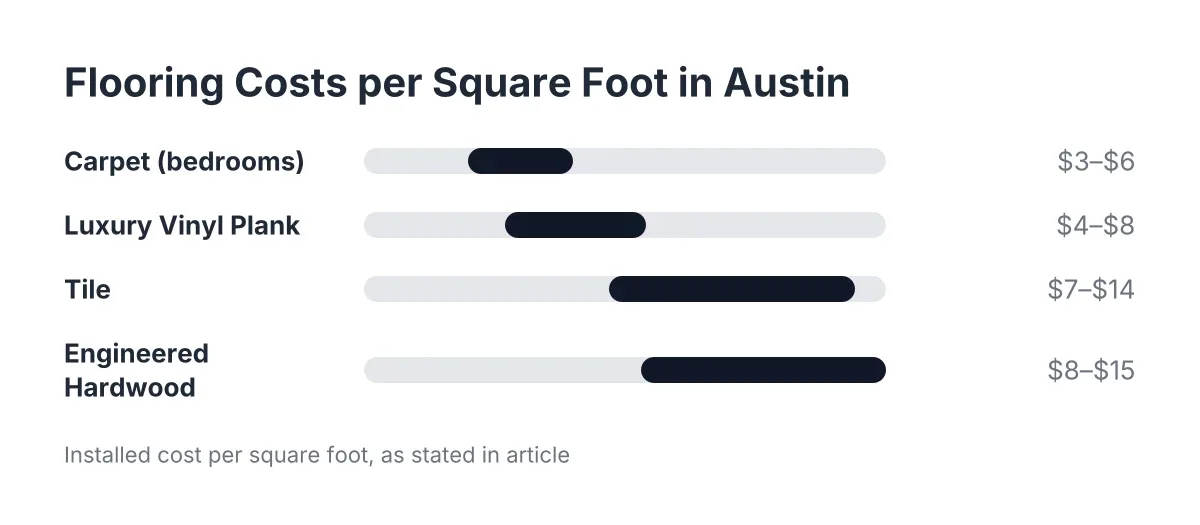
Expect installed costs in the range of about $8 to $15 per square foot depending on species and plank width, though you should get an estimate for your specific house since subfloor prep drives the number. In neighborhoods like Tarrytown, Zilker, and Travis Heights, buyers expect wood in the main living areas, and hardwood flooring installation done before move-in avoids the misery of doing it around furniture later. Choose a mid-tone natural finish; heavy gray stains and glossy exotic species date fast.
3. Luxury Vinyl Plank: The Practical Winner for Most of the Metro
Luxury vinyl plank, or LVP, is the right call for most families renovating a suburban home before move-in, and Austin buyers no longer treat it as a compromise. Quality LVP is fully waterproof, shrugs off dogs and kids, and installs at roughly $4 to $8 per square foot, about half the cost of engineered wood. In Cedar Park, Leander, Kyle, and Buda, well-chosen LVP reads as move-in ready, which is what buyers in those areas want.
The hardwood vs LVP flooring question usually comes down to price point and neighborhood. Under about $600,000 in the suburbs, good LVP performs at resale nearly as well as wood. Above that, and in close-in neighborhoods, buyers expect real wood underfoot and will notice the difference. The failure mode with LVP is buying cheap: thin wear layers under 12 mil scratch and dent, and a floor that fails in three years costs you twice.
Where LVP Beats Wood for Best Flooring Value and Resale Performance
Kitchens, laundry rooms, and any home with a pool or big dogs favor LVP because water is its native environment. It is also the better pick for rentals and for garage conversions or an ADU, where durability per dollar matters more than prestige. If you are converting a garage in East Austin into a rentable unit, LVP over a properly prepped slab is the standard play.
4. Tile Where Austin Summers and Water Demand It
Porcelain tile earns its keep in bathrooms, mudrooms, and covered patio transitions, and it stays cool through a 105-degree August. In the tile vs laminate flooring debate, tile wins every wet room without argument; laminate swells when water gets under it, and Austin buyers who have owned a house here know that. Installed tile typically runs about $7 to $14 per square foot depending on format and layout.
However, resist tiling the whole house. Wall-to-wall tile in living areas reads dated to most Austin buyers outside of Mediterranean-style homes in Westlake or Lakeway, and it is unforgiving underfoot and expensive to remove later. Use tile deliberately: bathrooms, laundry, entry if it takes weather, and stop there.
5. Retire the Carpet Everywhere Except Bedrooms, Maybe
Carpet in main living areas is the fastest way to lose an Austin buyer's interest, and even in bedrooms it is now optional rather than expected. If the house you bought has carpet over original hardwood, common in older Hyde Park and Travis Heights homes, pull a corner and check before you price anything; refinishing existing oak often costs less than new material. Fresh carpet in bedrooms is fine and cheap, usually $3 to $6 per square foot installed, but hard flooring throughout no longer hurts resale.
Allergies are part of this shift. Cedar season is a shared Austin experience, and buyers with allergies actively prefer hard surfaces they can damp-mop. When you are choosing flooring for a future home sale, carpet is the one material trending against you.
6. Match the Flooring Choice to Home Resale Price Band, Not Pinterest
The right floor is the one buyers at your home's future price point expect, and mismatches cost money in both directions. Put $14-per-foot wide-plank white oak in a starter home in Hutto and you will not get it back; put builder-grade LVP in a $1.2 million Tarrytown remodel and buyers will discount the whole renovation. Price the floor to the house it will be at resale, not the house it is today.
This is where a broker-led team differs from a pure contractor. A contractor prices the install; a broker prices what the finished house sells for. Before you commit to a material, ask someone who lists homes in your neighborhood one question: what flooring do the comps that sold fastest have? In our work across the Austin metro, that answer decides the scope more often than any showroom sample.
7. Budget for the Slab, Not Just the Planks
Subfloor prep is the line item that blows up flooring budgets in Austin, so build it into your estimate from day one. Most Austin homes sit on slab foundations, and our clay soil moves them; an out-of-level slab needs grinding or self-leveling compound before any plank goes down, and skipping that step is why floors click, bounce, and gap within a year. During your pre-close walkthrough or inspection period, have someone check the slab for moisture and level, not just the finish floor.
For example, say a buyer in Georgetown budgets $9,000 for 1,500 square feet of LVP and the crew finds a half-inch dip across the family room. Leveling might add $1,000 to $2,500 in that scenario, and finding out mid-project with a move-in date fixed is the stressful version. This is the main reason flooring installation quotes vary so widely between contractors; the cheap bid usually assumes a perfect slab, and Austin slabs rarely are. If your inspection flagged foundation movement, get a foundation professional's read before installing rigid flooring at all.
8. Sequence the Floors Right in a Pre-Move-In Renovation
Flooring goes in after the messy trades and before you move a single box, and getting that order right is what protects your move-in date. If you are also doing a kitchen remodel, bathroom work, or paint, the floor is one of the last items in the sequence, not the first. A managed project runs the trades in order so the new floor is not sacrificed to a drywall crew.
The working sequence for a between-closing-and-move-in renovation:
- Demolition, and any foundation or plumbing work under the slab
- Framing, electrical, and drywall repairs
- Cabinet installation in kitchens and baths
- Ceiling and wall paint, first coats
- Flooring installation, including laminate flooring installation acclimation time, which needs 48 to 72 hours in the house before install
- Baseboards, trim, and final paint touch-ups
- Punch-list walkthrough before the moving truck arrives
Searching "flooring installation near me" gets you a floor crew; it does not get you someone who owns this sequence. If you hire trades separately, you become the scheduler, and every day the painter and the floor crew collide is a day closer to moving into a jobsite. One team managing the scope, with its own subcontractor network, exists to prevent exactly that.
The Short Version for Austin Buyers Renovating Before Move-In
Flooring choice drives home resale value in Austin more through consistency and fit than through any single premium material. Run one floor through the main living areas. Choose engineered hardwood for close-in and higher-priced neighborhoods, quality LVP for most of the suburban metro, tile only where water lives, and carpet nowhere buyers will judge it. Budget for slab prep, and sequence the floors near the end of the renovation, before the boxes arrive.
Do it now, between closing and move-in, and you pay once, move once, and live on finished floors from the first night. Do it later and you pay in disruption. Either way, price the decision against what buyers in your neighborhood pay for, because in a market where homes sit longer than they did three years ago, floors are one of the first things that decide whether yours does.
If you need pre-listing home renovation, Lujo Realty can help.
Prefer to talk it through? Call Lujo Realty — a quick call is usually the fastest way to get a straight answer for your situation.