Flooring Installation Timeline: How Long Before Your Austin Home Is Move-In Ready?
If you just closed on a fixer in the Austin metro and want the floors done before moving day, the honest answer is that a flooring installation timeline runs long or short depending on three things: the material you pick, the condition of the subfloor, and how well the job is scheduled around your other trades. Understanding your flooring timeline before move-in is essential when you're working against a fixed closing and moving date. Most single-family homes land somewhere between 2 days and 3 weeks. That spread is wide, and it is exactly why buyers renovating between closing and move-in get burned. This guide walks you through the timeline step by step so you can pick a material Austin buyers pay for, book the work in the right order, and hit your move-in date with room to spare.
One note before we start. The steps below assume a whole-home or main-level job of roughly 1,000 to 2,000 square feet, which is the typical scope we see across Hyde Park bungalows, Travis Heights remodels, and newer builds in Round Rock and Kyle. A single room compresses everything; a two-story with stairs stretches it.
Step 1: Pick Your Material With the Timeline in Mind
Material choice sets your clock before anyone swings a hammer. This is the decision most first articles skip, and it is the one that matters most if your closing date and move-in date are fixed.
Here is how the common options compare on installed speed for a typical 1,500 square foot main level, as illustrative ranges:
- Luxury vinyl plank (LVP): 2 to 4 days. Click-lock LVP floats over the subfloor, needs no acclimation in most cases, and you can walk on it the same day. For rental turns and lease-ups, this is why investors default to it.
- Laminate: 2 to 4 days of install, plus 24 to 48 hours of acclimation in the house first. Laminate flooring installation cost runs lower per square foot than hardwood, but it trades away moisture tolerance.
- Prefinished hardwood: 4 to 7 days of install, plus 3 to 5 days of acclimation. No on-site sanding or finishing, so you skip the dust and cure time.
- Site-finished hardwood: 2 to 3 weeks. Acclimation, install, sanding, staining, and two or three coats of finish, each with dry time. Then days more before furniture and a week or two before rugs.
- Tile: 5 to 10 days. Mortar and grout each need cure time, and large-format tile over an uneven slab needs leveling first.
On the hardwood vs LVP flooring question, Austin buyers still pay a premium for real wood in close-in neighborhoods like Tarrytown, Zilker, and Hyde Park, where comps support it. In most of the metro, a quality wide-plank LVP reads well at showings, handles our slab foundations and humidity swings, and cuts your timeline by two weeks or more. If you are choosing flooring for a home sale rather than your forever house, that tradeoff usually favors LVP outside the premium hardwood neighborhoods.
Step 2: Measure the Real Scope, Not Just the Square Footage
Walk the house and count everything that adds days: stairs, transitions between rooms, closets, existing tile that has to come out, and any floor that feels soft or slopes. Demo of old flooring adds 1 to 2 days on its own. Tile demo on a slab is slow, loud work and can add more.
Subfloor condition is the single biggest schedule wrecker in older Austin housing stock. Suppose you buy a 1948 pier-and-beam in East Austin and the inspection flagged sloping floors. Once the old flooring comes up, the crew may find joist repairs or leveling work that adds 2 to 5 days before a single plank goes down. On slab homes in Pflugerville or Leander, moisture testing and self-leveling compound can add 1 to 2 days. Budget schedule cushion for what you cannot see yet.
This is also where a walkthrough with someone who prices work against resale value earns its keep. Not every soft spot needs a full subfloor rebuild before a sale, and not every slope is worth chasing to zero. A pro can tell you which fixes buyers and inspectors care about and which ones just burn days.
Step 3: Book the Crew and Order Material Early: Your Flooring Timeline Before Moving
Lead time is part of your flooring timeline before move-in; a long wait for material or a booked-out crew delays the job as surely as slow work does. As of 2026, in-stock LVP and laminate from local suppliers can be on site in days. Special-order hardwood, specific tile, or anything from a design package can take 2 to 6 weeks to arrive. Order before you close if your contract and lender allow the coordination, and confirm the material is physically in the warehouse, not just listed as available.
When you search for flooring installation contractors near me, you will get a wide spread of bids and start dates. Three questions separate the pros from the headaches:
- When can you actually start, and is that date held or tentative?
- Who handles demo, haul-off, subfloor prep, and baseboards, or are those separate trades I have to hire?
- What happens to the schedule if you open the floor and find damage?
A managed project with one team running its own subcontractor network answers all three up front. Hiring a flooring installer, a demo crew, and a trim carpenter separately means you become the scheduler, and every handoff between trades is a place the timeline slips.
Step 4: Sequence Your Flooring Installation Before Other Trades Complete
If floors are part of a bigger pre-move-in remodel, order of operations decides whether your flooring timeline before move-in stays short or gets longer. The standard sequence: demolition first, then plumbing and electrical rough-in, then drywall and ceiling paint, then cabinets in the kitchen, then floors, then baseboards and final wall paint touch-up.
Put floors in too early and every trade after them scratches, drips on, or dents your new investment. Put them in too late and you cannot set appliances or finish trim. For example, in a kitchen remodel plus whole-home flooring, the floors typically go in during the last third of the project, after cabinets are set but before countertop install and appliance delivery.
For a renovate-before-move-in buyer, this sequencing is the strongest argument for doing the work while the house is empty. An empty house lets crews run rooms in parallel instead of shuffling your furniture zone to zone, which alone can cut days off the schedule and keeps your family out of a construction zone entirely.
Step 5: Build In Acclimation and Cure Time
Acclimation is the step impatient schedules cut, and it is the step that causes gapping, cupping, and callbacks six months later. Wood and laminate need to sit in the house, with the HVAC running at normal living temperature, so the material adjusts to indoor humidity before install. In Austin's climate, where outdoor humidity swings hard between a wet spring and a dry August, skipping this on hardwood is asking for trouble.
Plan for these holds, as general guidance:
- Solid hardwood: 3 to 5 days of acclimation, sometimes longer for wide planks
- Engineered hardwood and laminate: 24 to 72 hours
- LVP: usually none, though the house should be climate-controlled
- Site-finished hardwood: after install, each finish coat needs dry time, and full cure before rugs can take 1 to 2 weeks
Tile has its own version: mortar cures before grout, grout cures before sealing, and heavy traffic waits until both are done. None of this is wasted time if you plan for it. All of it is a crisis if you scheduled the moving truck for the day after the last plank.
How Long Should You Plan Between Closing and Move-In?
For flooring alone, plan 1 to 2 weeks between closing and move-in for LVP or laminate, 2 to 3 weeks for prefinished hardwood or tile, and 3 to 4 weeks for site-finished hardwood, including cushion for lead time and subfloor surprises. Those are planning ranges, not quotes; get an estimate against your actual house.
Say a family closes on a dated 4-bedroom in Cedar Park on the first of the month and wants to move in by the first of the next. That gives them about four weeks. In that scenario, in-stock LVP throughout with a week of cushion is comfortable. Site-finished oak throughout is not; one rain-delayed finish coat or one subfloor repair and they are moving boxes onto floors that are not ready.
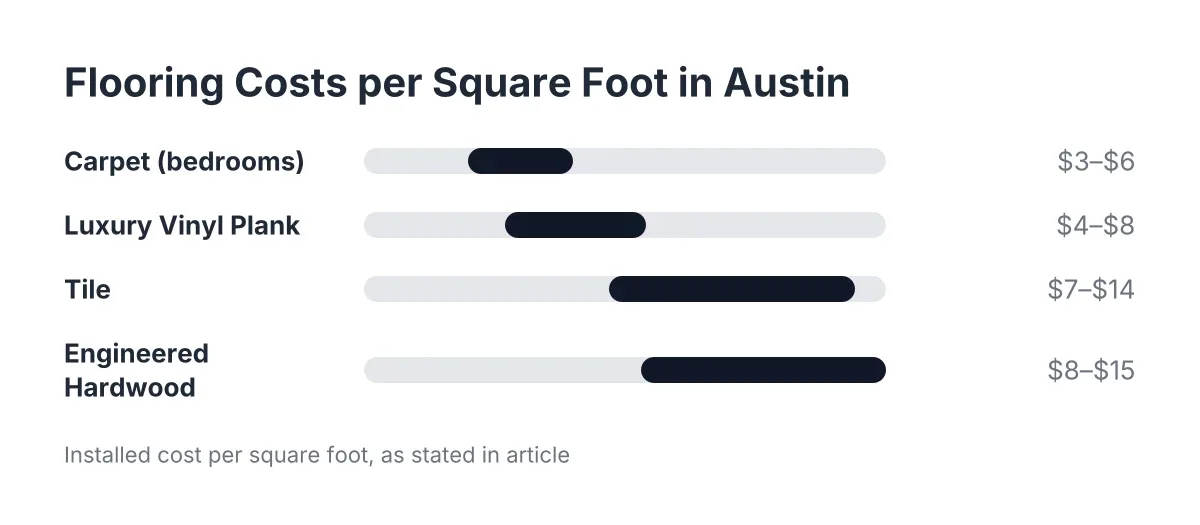
Cost interacts with the timeline too. Hardwood flooring installation cost runs meaningfully higher per square foot than LVP or laminate once you add acclimation, finishing, and the longer crew commitment, which is part of why the faster materials also tend to be the budget-friendly ones. If you have already spent your cushion on the down payment, that matters. NAR's 2025 Profile of Home Buyers and Sellers found the median first-time buyer is now 40 years old, according to the National Association of Realtors; buyers are stretching further to get into a house, and few have slack in the budget or the calendar for a floor job that drifts.
One honest limitation: no article can tell you what is under your existing floor. If your inspection flagged foundation movement, prior water damage, or significant slope, have a professional open up a section and assess the subfloor before you lock a move-in date to a flooring schedule.
The Short Version
Pick the material first, because it sets the clock. Choose LVP or laminate when speed and budget lead; choose hardwood where your neighborhood's comps reward it and your timeline allows it. Order material before you need it, hire one team that controls demo through baseboards, sequence floors late in the renovation, and protect the acclimation and cure days instead of stealing them. Do that, and the floors are done before the truck arrives, and you move once.
If you need pre-listing home renovation, Lujo Realty can help.
Prefer to talk it through? Call Lujo Realty — a quick call is usually the fastest way to get a straight answer for your situation.