Hardwood vs. Laminate Flooring: What Austin Buyers Actually Pay For
You just closed on a fixer in Crestview, or you are about to, and the floors are the first thing you noticed on the walkthrough. Worn carpet in the bedrooms, scratched laminate in the hall, maybe a slab crack under the living room. Now you are comparing hardwood floor types against laminate and luxury vinyl plank, and every contractor bid tells you something different. This guide cuts through that. It covers what each material costs to install in the Austin metro, how it holds up, and which choices Austin buyers reward at resale, because national trend lists do not account for a slab-on-grade house in Central Texas heat.
Here is the honest version up front. Hardwood costs more, demands more care, and returns more when you sell in the neighborhoods where buyers expect it. Laminate and LVP cost less, shrug off kids and dogs, and read as a sensible upgrade in most of the metro. The right answer depends on your house, your timeline, and how long you plan to stay. Let us work through it.
Why Flooring Is the Highest-Leverage Decision in a Pre-Move-In Renovation
Flooring touches every room, every showing, and every day you live in the house. It is also the one project that gets dramatically harder after you move in. Refinishing hardwood or demoing tile in an occupied house means moving furniture room by room, sealing off dust, and living around drying finish for days.
That is why buyers renovating between closing and move-in day usually put floors first on the scope. An empty house is the cheapest, fastest place to do this work. A typical crew can demo and install flooring across a 2,000 square foot empty home in a fraction of the time the same job takes with a family living in it.
The same logic applies if you have owned your home for fifteen years and plan to stay another twenty. Flooring is underfoot for every year of that plan. Choosing a material that fights Austin's climate, or one that will not survive your grandkids and the dog, means paying for the project twice.
However, flooring is also where budgets go sideways. The material is only part of the cost. Subfloor prep, leveling a slab, moving baseboards, and transitions between rooms add real money, and they are the line items that vary most between bids. Understanding the materials first makes you a sharper reader of every estimate that lands in your inbox.
The Main Hardwood Floor Types, and Why the Distinction Matters in Austin
Hardwood floor types break into two structural categories, solid and engineered, and the difference matters more in Austin than in most markets. Nearly every home here sits on a concrete slab. Solid hardwood cannot be nailed directly to concrete, while engineered hardwood can be glued or floated over it. That single fact decides the question for most Austin houses before species or stain ever comes up.
Solid hardwood
Solid hardwood is one piece of wood, usually three quarters of an inch thick, milled from a single board. Its defining advantage is lifespan. You can sand and refinish it five or more times, which means a solid oak floor installed today can outlive the mortgage.
The catch for Austin: solid wood needs a nailable wood subfloor. If your home is pier-and-beam, common in older Hyde Park, Travis Heights, and East Austin houses, solid hardwood is on the table and often the right call. Buyers in those neighborhoods expect original or period-appropriate wood, and refinishing existing oak strip flooring is frequently cheaper than replacing it.
Solid wood also moves with humidity. Central Texas swings from bone-dry summers with the AC running constantly to damp winter stretches. Wider planks show gapping and cupping more than narrow strips, so acclimation before installation and a stable indoor climate matter.
Engineered hardwood
Engineered hardwood is a real wood wear layer bonded to a plywood or high-density core. It looks identical to solid wood underfoot because the surface is genuine wood. The layered core makes it dimensionally stable, so it handles humidity swings and glues down cleanly over a slab.
For the majority of Austin homes built from the 1970s onward, engineered is the practical hardwood choice. The variable to watch is wear layer thickness. A 2 millimeter wear layer might allow one light refinish; a 4 to 6 millimeter layer behaves closer to solid wood over decades. Thicker wear layers cost more, and cheap engineered product with a paper-thin veneer is the trap to avoid.
Species, and what the pictures do not tell you
Browsing hardwood floor types by pictures alone hides the durability story. Species hardness determines how the floor handles dogs, chair legs, and dropped toys:
- White oak: The Austin default in 2026. Hard, takes stain evenly, and matches what buyers see in renovated Tarrytown and Zilker listings. Light, natural finishes dominate.
- Red oak: Common in older homes, slightly softer, with a pinkish undertone. Refinishing existing red oak with a neutral stain modernizes it inexpensively.
- Hickory: Harder than oak, strong choice for big dogs and heavy traffic, with pronounced grain variation that not everyone loves.
- Maple: Hard but tricky to stain evenly; usually kept natural.
- Walnut: Beautiful and dark, but softer, so it dents. Better for low-traffic rooms than a family kitchen.
- Pine: Soft and easily dented. In a 1930s Travis Heights bungalow, original longleaf pine with character marks is an asset. As a new install for a busy household, it is a maintenance commitment.
As for what is cheapest, red oak and lower-grade white oak in narrower widths generally anchor the affordable end of hardwood flooring types of wood, while wide-plank walnut and specialty parquet floor patterns sit at the top.
What Laminate and LVP Actually Are, and Where They Win
Laminate is a photographic image of wood on a fiberboard core with a clear wear layer on top. Luxury vinyl plank is a similar idea built on a vinyl core, which makes it waterproof rather than just water-resistant. In 2026, most Austin installers steer clients toward quality LVP over traditional laminate because the waterproof core handles kitchen spills, bathroom humidity, and the occasional water heater incident that laminate cannot.
These products win in specific situations:
- Wet and messy zones. Kitchens, laundry rooms, and mudrooms where standing water would eventually damage wood.
- Rentals and hard-use households. Three kids, two dogs, and a swim bag dripping by the back door will not faze a good LVP wear layer.
- Budget-constrained whole-house jobs. When the down payment already stretched the budget, LVP lets you replace every floor in the house instead of hardwood in half of it.
- Slab houses with moisture questions. Vinyl cores tolerate minor slab moisture that would cup a wood floor.
The tradeoff is permanence. You cannot refinish laminate or LVP. When the wear layer goes, the floor gets replaced. A hardwood floor scratched by a decade of dog claws gets sanded and looks new; an LVP floor with the same decade of wear gets torn out. Over a thirty-year ownership horizon, one hardwood install plus a refinish can cost less than two full LVP replacements.
There is also a perception floor. Buyers touring a $500,000 house in Pflugerville read quality LVP as a clean, modern upgrade. Buyers touring a $1.5 million house in Westlake or Tarrytown notice it immediately, and not favorably. Material has to match the price point of the home.
Comparing Hardwood Floor Types and Laminate on Cost, Installed
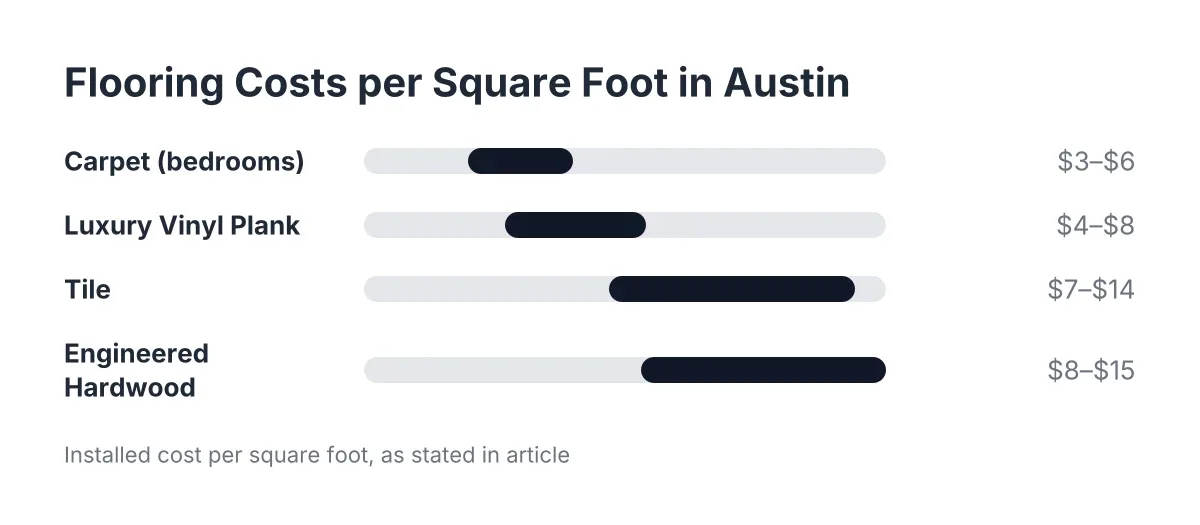
Installed cost is what matters, not the per-plank price at the store. As illustrative 2026 Austin metro ranges, expect quality LVP to run about $4 to $8 per square foot installed, engineered hardwood about $8 to $15, and solid hardwood about $10 to $18 or more depending on species and width. Refinishing existing hardwood often lands around $3 to $6 per square foot, which is why we check what is under the carpet before quoting anything.
Treat those as planning ranges, not quotes. Hardwood flooring cost swings with subfloor condition, plank width, finish choice, and how much furniture and baseboard work the job includes. An accurate number requires a walkthrough and a written scope; get an estimate before you commit a budget line.
To rough out your own number, use a flooring calculator: square feet of each room, plus 8 to 10 percent for waste and cuts, multiplied by the installed range for your material. A 1,900 square foot house with 1,400 square feet of flooring to replace lands around $8,400 to $11,200 in LVP and $12,300 to $23,000 in engineered hardwood at those illustrative rates. That gap is real money, which is exactly why the resale side of the equation deserves attention before you default to the cheaper line.
Watch for these cost drivers hiding in every flooring installation bid:
- Demo and haul-off of existing tile, which is slow, dusty work on a slab.
- Slab leveling or moisture mitigation, common in older East Austin and South Austin homes.
- Baseboard removal and reinstallation, or new baseboards entirely.
- Transitions and thresholds between flooring types and at exterior doors.
- Stair treads, which price per step and add up fast in two-story homes.
When bids from three contractors come back thousands of dollars apart, the difference usually lives in these line items, not the material. Compare scopes line by line before comparing totals.
What Austin Buyers Actually Pay For at Resale
National articles rank flooring for resale in the abstract. Austin buyers behave in specific, observable ways, and having listed and prepared homes across the metro shapes how we advise clients on this.
First, continuous flooring sells. A single material running through the main living areas makes a house read larger and newer. Patchwork transitions, carpet in one bedroom, laminate in the next, tile in the hall, read as deferred maintenance even when each floor is fine.
Second, real wood carries weight in the central neighborhoods. In Hyde Park, Tarrytown, Zilker, and Travis Heights, buyers expect hardwood and will mentally deduct for anything else. Refinishing original oak in these homes is often the highest-leverage flooring dollar you can spend.
Third, in the suburban metro, from Round Rock and Cedar Park to Kyle and Buda, quality wood-look LVP in a current color satisfies most buyers, and the savings can fund a bathroom remodel that moves the needle more. Material should match neighborhood expectations, not exceed them by two price tiers.
Fourth, carpet has retreated to bedrooms, and even there it is optional. Wall-to-wall carpet in living areas is the one flooring choice that consistently costs sellers at negotiation time.
Context matters for how much you spend, too. According to the National Association of Realtors, the median age of first-time home buyers hit a record 40 years old in 2025, and first-time buyers fell to a historic low of 21 percent of the market. The buyer for your future listing is likely older, established, and comparing your floors against renovated competition, not settling for a project house. Locally, Unlock MLS's Homeowner Affordability Index found every additional $100 a month in carrying costs pushes an estimated 9,800 Central Texas households into financial strain, which is a reminder that stretched buyers pay for move-in ready and discount anything that means writing another check after closing.
We will be straight about the limits here: no one can promise a specific resale return on any floor, and anyone who does is selling you something. What flooring reliably does is remove objections and keep a house competitive with other renovated listings.
Matching the Material to Your Situation
The right floor depends on which reader you are, so consider two hypothetical Austin households.
Suppose a family goes under contract on a 1985 house in Cedar Park with a closing date six weeks out. The house has original carpet and worn laminate, the budget is tight after the down payment, and the goal is to move once, into a finished house. In that scenario, whole-house LVP in a warm white-oak tone is the defensible call. It is waterproof for the kids and the dog, it installs fast in an empty house so the timeline holds, and it frees budget for paint and punch-list repairs before moving day. One managed project, one team of trades, done before the truck arrives.
Now suppose a couple in their early sixties has owned a Northwest Hills home since 2005 and plans to stay through retirement. They are pulling carpet partly because hard, even flooring is safer as they age; fewer transitions and thresholds mean fewer trip hazards. With a 20-year horizon and no sale planned, engineered white oak with a thick wear layer earns its price. It can be refinished once or twice over their tenure, it feels like the house they want to grow old in, and the cost spreads across decades of daily use.
A few situations call for a professional opinion before you order material. Slab moisture readings, unlevel floors in older pier-and-beam homes, and existing hardwood of uncertain thickness all change what should go down and what it will cost. A walkthrough with someone who installs floors across the Austin metro every week settles those questions faster than any article can.
The Short Version
Hardwood floor types come down to solid versus engineered, and on Austin's slab foundations, engineered wins most installs while solid rules pier-and-beam originals worth refinishing. Laminate and LVP win on price, water resistance, and speed, but cannot be renewed and read as a downgrade in premium central neighborhoods. Spend where your neighborhood and your timeline justify it.
If you are renovating before move-in, decide flooring first, because it sets the schedule for paint, kitchen work, and everything else in the scope. If you are upgrading to stay, buy the floor for the next twenty years, not the next listing photo. Either way, the empty-house window and a single accountable team managing the work are worth more than any single material choice.
If you need pre-listing home renovation, Lujo Realty can help.
Prefer to talk it through? Call Lujo Realty — a quick call is usually the fastest way to get a straight answer for your situation.