Painting House Interior Cost in Austin: What Drives the Price in 2026
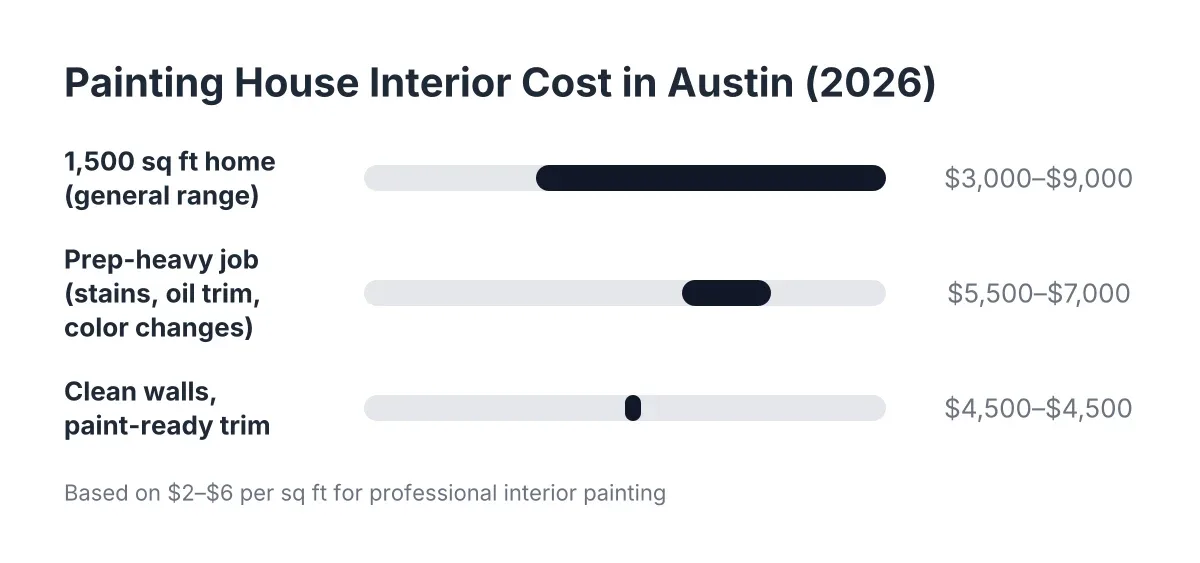
You closed on the property. Now you need to know what painting the house interior will cost before you commit a line in the renovation budget. In the Austin metro in 2026, painting house interior cost typically runs $2 to $6 per square foot of floor area, or roughly $3,000 to $9,000 for a 1,500 square foot home, depending on prep work, ceiling height, and how many colors you run. Those are illustrative estimates; the real number comes from a walkthrough and a written scope.
This guide walks through the process the way we run it on managed projects across the Austin metro: scope it, price it, spec it, and get it done without change orders eating your margin. Interior paint is one of the highest-return, lowest-cost items in any pre-listing prep or rental turn, but only if you scope it like an investor instead of buying a number off the phone.
Step 1: Decide What the Paint Job Has to Do for the Property
Interior paint serves one of three jobs, and each carries a different budget. Name the job before you get a single bid.
- Rental turn. One neutral color throughout, durable finish, fast turnaround. Lowest cost per square foot. You are buying speed and washability, not design.
- Sell-ready refresh. Walls, trim, and doors in a current neutral, plus ceilings where they show water stains or dated texture patches. This is where paint earns the most at showings.
- Full remodel repaint. Paint follows drywall repair, new trim, and cabinet work. Highest prep cost, and sequencing with other trades matters more than the paint itself.
However you plan to exit, the Austin market punishes dated interiors right now. Homes are sitting longer; Austin's median home value dropped 2.3% to $429,869 in Q1 2025 as inventory climbed, according to LRG Realty. In that environment, a buyer walking into scuffed builder beige in a Travis Heights or East Austin listing mentally deducts far more than the repaint would have cost. On the rental side, softer rents mean the same thing: Apartment List data shows average two-bedroom rent in the Austin area fell 19.9% from its 2022 peak to $1,382 by October 2025, with vacancy near 9.71%. A crisp, freshly painted unit leases faster in a renter's market. Paint is how you compete without cutting price.
Step 2: Measure the Scope Before You Ask for Numbers
Painters price walls, not floor plans, so translate your property into paintable scope. Walk each room and note four things: wall condition, ceiling height, trim and door count, and anything that needs repair before paint.
Interior painting cost per square foot is a useful shorthand, but it only holds when the underlying conditions match the assumption. A 1,500 square foot bungalow in Hyde Park with 12 foot ceilings, original plaster cracks, and stained trim is a different job than a 1,500 square foot 1990s house in Pflugerville with 8 foot ceilings and drywall in decent shape.
Flag these cost drivers on your walkthrough list:
- Drywall or plaster repair. Nail pops, tape seams, and texture matching add labor before a brush touches the wall.
- Popcorn or dated ceiling texture. Scraping and refinishing can add several thousand dollars on a whole house; budget it separately from paint.
- Dark or saturated existing colors. They need extra coats or a priming pass.
- Trim, doors, and cabinets. Enamel work is slower than walls and priced separately. Painting cabinets can transform a dated kitchen for a fraction of replacement cost.
- Occupied versus vacant. Vacant properties paint faster and cheaper. If you are turning a tenant, schedule paint for the vacancy window.
Step 3: What Painting a House Interior Costs in Austin
How much does painting a house interior cost? In the Austin metro in 2026, expect roughly $2 to $6 per square foot of floor area for professional interior work, so about $3,000 to $9,000 as the cost to paint a 1,500 sq ft house interior, walls and trim included. Prep-heavy older homes, tall ceilings, and multiple colors push toward the top of that range. Treat these as planning estimates and get a written scope for your specific property.
Here is why the range is wide. Labor is most of the bill, and labor scales with prep, cut-in complexity, and coats, not raw square footage. Two identical floor plans can price a thousand dollars apart because one needs skim coating and the other needs a light sand and two coats.
For example, suppose you just closed on a 1970s three-bedroom near Manor as a hold. Walls are sound but every room is a different color, trim is oil-based and yellowing, and two ceilings have water stains from a repaired roof leak. A typical crew would prime the stained ceilings, bond-prime the oil trim before switching to a modern enamel, and run one neutral throughout. In that scenario the job might land around $5,500 to $7,000, while the same square footage with clean walls and painted-ready trim might come in under $4,500.
A house painting interior cost calculator online gets you in the neighborhood, but it cannot see your plaster cracks or your trim condition. Use calculators to sanity-check bids, not to set the budget.
DIY vs Professional Painting for an Investor
DIY painting saves labor, which is 70 to 85 percent of the job, but it costs you weeks of holding time. On an investment property, run the math on carrying costs, not just the paint bill. Unlock MLS's Homeowner Affordability Index found that every additional $100 a month in carrying costs pushes an estimated 9,800 Central Texas households into financial strain; your carrying costs on a vacant property compound the same way. If a crew finishes in four days what would take you three weekends, the professional job often pencils out even before you count finish quality. Cutting in 10 foot ceilings and spraying trim are also where amateur work shows at showings.
Step 4: Choose Colors That Perform at Austin Showings
The best paint colors to sell a house in Austin are warm whites and soft greige tones on walls, a clean white on trim and ceilings, and at most one accent moment, usually a front door or a powder room. Buyers touring listings in Zilker or Tarrytown respond to bright, light-bouncing interiors that photograph well, because most showings start on a phone screen.
Therefore, resist the urge to design for your own taste on a property you plan to sell or lease. One wall color, one trim color, one ceiling color across the whole house cuts labor, simplifies touch-ups at tenant turns, and reads intentional at a showing. Save personality for hardware, lighting, and landscaping.
A few working rules from the listing side:
- Skip stark, cool whites in older homes; they turn gray in low light and make original details look tired.
- Paint the ceiling. A fresh ceiling makes the whole room read new, and buyers notice the difference even when they cannot name it.
- Use satin or semi-gloss enamel on trim and doors, eggshell on walls. Flat wall paint scuffs in rentals.
- If you are also repainting outside, an exterior paint visualizer helps you test body and trim combinations against your actual facade photo before you commit; the same discipline applies indoors with large sample swatches on the wall.
Step 5: Get Bids Structured to Prevent Change Orders
Change orders on paint jobs come from unscoped prep, not from paint. Get every bid in writing with prep itemized: drywall repair, priming, caulking, number of coats, and which surfaces are included. "Paint interior, $4,800" is not a scope; it is an argument waiting to happen in week two.
In addition, ask each bidder to price walls, ceilings, trim, doors, and closets as separate line items. Line items let you value-engineer honestly. On a tight rental budget you might defer closet interiors and keep the ceiling work; on a sell-ready project in Westlake you keep everything and add the cabinets. This is where working with painting services managed by a team that also lists homes changes the conversation, because the scope gets built around what moves the sale price in that neighborhood, not around what is easiest to bid. With Austin's median sale price at $476,800 in Q3 2025 according to Redfin, a few thousand dollars of well-aimed paint is a small line against the number the finish quality influences.
Keep Painting a House Interior Cost Disciplined Against Your Exit Number
Set the paint budget as a percentage of your total renovation budget, then hold it. If painting house interior costs start creeping past plan because the walkthrough missed prep work, take the hit once, in writing, before work starts, not through a series of mid-job additions. On a managed project, our subcontractor team scopes prep during the initial walkthrough for exactly this reason: the estimate you approve should be the invoice you pay.
One honest limitation: paint cannot fix everything, and it should not try. Active moisture stains, cracking that suggests foundation movement, or lead paint in pre-1978 homes need a professional assessment before anyone paints over them. Covering a symptom you have not diagnosed costs more later, and in a sale it can surface on the inspection report at the worst possible time.
Step 6: Sequence Paint Correctly Inside the Larger Project
Paint lands near the end of a renovation, after drywall, trim carpentry, and cabinet installation, but before flooring goes in wherever possible. Painting over new floors means floor protection labor and slower work; painting before floors lets the crew move fast and spray where spraying makes sense.
Next, block the calendar realistically. A vacant 1,500 to 2,000 square foot interior typically takes a professional crew several days to a week, depending on prep. Add drying windows before flooring installation or tenant move-in. If the same property is getting exterior work, remember that exterior repaint cycles in Central Texas sun run shorter than national rules of thumb suggest; south and west elevations fade first, so inspect those when you assess how often to repaint the exterior on a hold property.
Finally, do a punch walk in daylight before you release final payment. Check cut lines at the ceiling, enamel coverage on door edges, and touch-ups where other trades worked after the painters. Ten minutes with painter's tape marking misses saves a callback after the listing photos are booked.
What the Interior Paint Line Should Look Like in Your Budget
For a post-purchase renovation in the Austin metro, plan interior paint as one of the first lines you fund and one of the last tasks you execute. As a planning framework: measure the scope room by room, price it against the $2 to $6 per square foot range, spec one neutral scheme the local buyer pool responds to, and lock prep into the written estimate. Whether the property is a Kyle rental turn or a pre-listing prep in Georgetown, the discipline is the same. Paint is cheap relative to what it does at a showing; the cost of skipping it shows up in days on market, and in this inventory environment, days on market is the expensive part.
If you need pre-listing home renovation, Lujo Realty can help.
Prefer to talk it through? Call Lujo Realty — a quick call is usually the fastest way to get a straight answer for your situation.