How Much Do Painting Services Cost?
Interior painting cost in Austin comes down to three things: how much wall surface you are painting, the condition of what is under the paint, and how much detail work the job includes. A freshly built home in Leander with clean drywall and simple trim prices differently than a 1940s Hyde Park bungalow with plaster cracks, crown molding, and layers of old paint. Anyone quoting a single number without seeing your home is guessing. By the end of this guide, you will know exactly what drives the price, what a real estimate should include, and how to get an accurate number for your own home.
What Drives the Cost of Painting Services
Painters price the work, not the house. Here are the factors that decide where your project lands.
Square footage and ceiling height
More surface means more labor and more paint. But square footage on your listing is floor space; painters care about wall and ceiling area. Two homes with the same floor plan can price differently if one has ten-foot ceilings or a two-story entry. Vaulted spaces need scaffolding or extension setups, which adds labor time. If your home has standard eight-foot ceilings throughout, you are on the lower side of this factor. Tall entries, stairwells, and open living rooms push you up.
Surface condition and prep work
Prep is where interior painting costs diverge the most. Clean, previously painted drywall needs light patching and primer in spots. Older Austin homes, especially in Travis Heights, Hyde Park, and parts of East Austin, often need crack repair, texture matching, water stain sealing, or skim coating. Every hour of prep is an hour of labor before a brush touches paint. Walk your rooms and look for nail pops, cracks at door corners, peeling spots, and stains. Few of them means less prep. A wall you would not want photographed means budget for repair first.
Scope: walls only, or walls, ceilings, trim, and doors
Walls alone is the fastest version of the job. Add ceilings and you add awkward overhead labor. Add trim, doors, baseboards, and cabinets and you add the slowest, most skilled work in the trade, because trim demands careful cutting-in, sanding, and often multiple coats of enamel. A whole-home repaint that includes every surface can run well beyond a walls-only refresh of the same house. Decide what actually needs paint before you ask for quotes, and say so clearly.
Paint quality and color changes
Paint itself is a smaller share of the bill than labor, but it still moves the number. Premium lines cost more per gallon and often cover better, which can offset some labor. The bigger driver is color change. Going from a dark accent wall to a light neutral, or the reverse, means extra coats and sometimes tinted primer. Keeping a similar color family means fewer coats. If you are repainting the same or a close shade, you are on the cheaper side of this factor.
Occupied home versus empty home
Painters work fastest in empty rooms. Furniture moving, floor protection, and working around a family's daily schedule all slow the crew down, and slower means more labor hours. If you are painting before a move-in or as part of pre-listing prep after you have moved out, the crew can work room to room without interruption, and the price reflects that. If you are living in the home, expect the estimate to account for protection and staging time.
Repairs the paint job uncovers
Paint hides problems until prep exposes them. Water stains can point to a roof or plumbing leak. Soft drywall, failing caulk, and rotted window trim need repair before paint will hold. A painter who only paints will quote around these problems; a managed project handles them in the same visit. Because our subcontractor team covers handyman repairs, drywall, and trim work alongside painting, we can fold those fixes into one scope instead of leaving you to find a second contractor mid-project.
Cost Factor Table
| Factor | Pushes the price down when… | Pushes it up when… |
|---|---|---|
| Square footage and ceilings | Standard eight-foot ceilings, compact floor plan | Vaulted ceilings, two-story entries, open stairwells |
| Surface condition | Clean drywall, minor nail holes | Cracks, texture repair, water stains, peeling paint |
| Scope of surfaces | Walls only, a few rooms | Ceilings, trim, doors, baseboards, and cabinets included |
| Color and paint choice | Similar color, mid-grade paint | Dramatic color change, premium enamel finishes |
| Occupancy | Empty home, crew works uninterrupted | Furnished, occupied, scheduling around your family |
| Hidden repairs | None found during prep | Drywall damage, rot, or leaks discovered mid-job |
How to Get an Accurate Painting Services Estimate
Online calculators that promise an interior painting cost per square foot give you a starting guess at best. They cannot see your ceiling heights, your trim, or the crack running above your kitchen door. The only accurate number comes from a walkthrough.
Here is what to have ready before anyone visits:
- A room list. Which rooms, and whether each includes ceilings, trim, and doors.
- Known problem spots. Stains, cracks, peeling paint, or previous patch jobs.
- Your color plan. Same shade, a close shade, or a dramatic change.
- Your timeline. Living in the home during the work, or painting an empty house before listing or move-in.
A good estimate spells out the scope in writing: which surfaces, how many coats, what prep is included, the paint brand and line, and who handles furniture and floor protection. If a quote is one line with a total, ask for the breakdown. Estimates differ between providers mostly because scopes differ; one painter's number includes ceiling repair and two coats of premium paint, another's covers one coat over existing color. Compare the scopes, not just the totals. Our guide to choosing a painting company in Austin covers the questions worth asking before you sign anything.
If you are painting as part of pre-listing prep, tell us that up front. We price the work with resale in mind, which usually means neutral colors buyers respond to and spending on the rooms photos will feature, not equal spending everywhere.
Ways to Keep the Cost Down
You do not need to cut corners to trim the number. You need to cut scope where it does not matter.
- Paint the rooms that count. For a sale, the kitchen, primary bedroom, living areas, and entry carry the weight. A guest room in decent shape can wait.
- Skip the ceiling where it is clean. Ceilings in good condition with no stains often do not need paint. Ask your estimator to price them as a separate line so you can decide.
- Stay in the same color family. Fewer coats, less primer, less labor.
- Empty the rooms yourself. Moving furniture to the center and removing wall hangings before the crew arrives saves paid labor hours.
- Fix small damage early. A caulked window and a sealed stain today prevents the rot repair and skim coat that would double a room's prep bill later.
Cost Questions People Ask
How much does it cost to paint a 1,500 sq ft house interior?
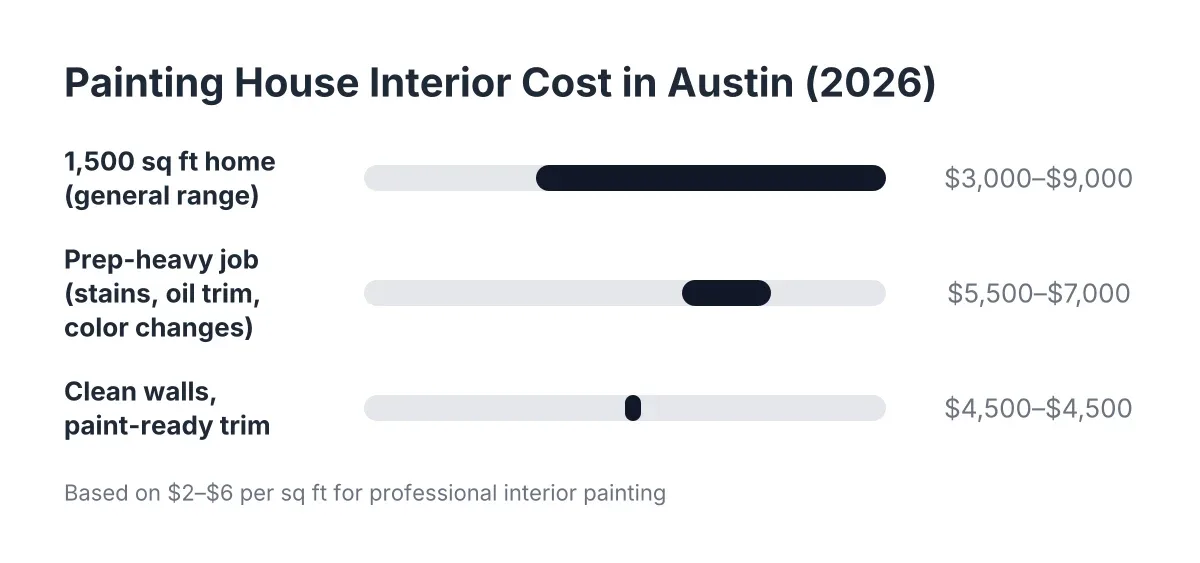
It depends on how many of those 1,500 square feet you are painting and what surfaces the job includes. A walls-only refresh in a home with standard ceilings sits at the low end; add ceilings, trim, doors, and heavy prep and the same house can cost twice as much or more. Get a walkthrough estimate with a room-by-room scope so you can see exactly where the money goes.
What is the interior painting cost per square foot?
Per-square-foot pricing is a rough shorthand, not a real quote, because it ignores ceiling height, prep condition, and trim work. Two 2,000-square-foot Austin homes can land far apart once an estimator sees them in person. Use per-foot figures to sanity-check quotes against each other, not to budget from.
How does exterior painting cost compare to interior?
Exterior painting usually costs more per comparable area because it involves pressure washing, caulking, wood repair, ladder and access work, and weather-resistant coatings. Siding material matters too; painting stucco, brick, and wood siding each price differently. Since we handle both interior and exterior painting across the Austin metro, one walkthrough can scope both and tell you whether bundling makes sense.
Should I paint before selling my home?
Usually yes, but selectively. Fresh neutral paint in the main living spaces is one of the more reliable pre-listing investments because buyers read worn paint as deferred maintenance everywhere. Because we list homes and manage the work, we will tell you which rooms earn their repaint at your price point in your neighborhood, and which do not need it.
The Bottom Line
The honest cost picture: your price hinges on surface area, prep condition, and scope, and no one can give you a real number without seeing the home. Gather two or three written estimates with itemized scopes and compare what each one actually includes. If you are in the Austin metro, call Lujo Realty at 512.749.4147 for a walkthrough and a written estimate, whether it is one room or a whole-house repaint before listing.
If you need pre-listing home renovation, Lujo Realty can help.
Related guide: painting services — Complete Guide
Prefer to talk it through? Call Lujo Realty — a quick call is usually the fastest way to get a straight answer for your situation.