What Is an ADU? Definition, Types, and Austin Zoning Rules Explained
If you own a home in the Austin metro and have a backyard or an underused garage, you have probably asked yourself two questions. What is an ADU? And could one work on my lot? The short answer: an ADU, or accessory dwelling unit, is a second, smaller home on the same lot as your primary residence, with its own kitchen, bathroom, and sleeping area. It can be a detached backyard cottage, a garage conversion, or an attached suite. In Austin, an ADU is both livable space and an asset. Done right, it adds square footage buyers pay for and can generate rental income while you own the home. Done wrong, it is an expensive shed with plumbing.
This guide covers the definition, the main types, what Austin zoning allows as of 2026, realistic costs, and how an ADU affects your property value and your sale, whether you plan to rent it out for years or list the house next spring.
What Is an ADU, Exactly?
An ADU is a self-contained secondary dwelling on a single-family lot. To count as a true accessory dwelling unit rather than a bonus room, it needs four things: a place to sleep, a full bathroom, a kitchen or kitchenette, and its own entrance. A pool house with no kitchen is not an ADU. A detached office with no bathroom is not an ADU. The distinction matters because the kitchen and permits are what make the space legally habitable, rentable, and countable in an appraisal.
You will hear other names for the same thing: granny flat, casita, backyard cottage, garage apartment, in-law suite, or secondary unit. In Austin's land development code, the official term is accessory dwelling unit, and that is the language your permit application, your appraiser, and your buyer's lender will use.
In real estate terms, an ADU typically refers to a second dwelling unit on a single residential lot. It sits on the same lot and the same deed as your main house. You cannot sell it separately in most cases, and it does not get its own tax parcel. It is an improvement to your property, the same way a second-story addition is, just detached or semi-detached.
The Three Main Types of ADU
Every ADU in Austin falls into one of three categories, and the type you choose drives cost, timeline, and permitting more than any other decision.
- Detached ADU. A standalone structure, usually in the backyard. New foundation, new roof, new utility connections. This is the most expensive type and also the one that performs best as a rental, because the tenant and the homeowner never share a wall.
- Attached ADU. Built onto the main house, often above or behind it, with a separate entrance. It shares a wall and sometimes utilities with the primary home, which cuts construction cost but reduces privacy.
- Garage conversion. An existing garage turned into living space. The structure, slab, and roof already exist, which makes this the fastest and usually the least expensive path to a legal second unit.
A junior ADU, meaning a small unit carved out of the existing house with a kitchenette, exists in some states' codes but is not a distinct category in Austin. Here, a converted interior space either meets the full ADU standard or it is simply part of the house.
Detached ADU vs Attached: Which Fits Your Goal?
Choose detached if rental income is the priority; choose attached or a garage conversion if budget or multigenerational living drives the project. A detached ADU rents more reliably because tenants value the separation, and it photographs as a true second dwelling when you sell. An attached unit or garage conversion costs less per square foot and suits an aging parent, a returning college kid, or a home office that might become a rental later.
There is a resale angle too. Buyers in neighborhoods like East Austin, Travis Heights, and Hyde Park have seen enough backyard cottages that a well-built detached unit reads as a feature, not an oddity. In more suburban parts of the metro, Round Rock or Cedar Park for example, a garage conversion can backfire if it removes the only covered parking on the street. Know your neighborhood before you give up the garage.
Austin ADU Rules: What Zoning Allows in 2026
Austin is one of the more ADU-friendly cities in Texas. The city's HOME initiative, phased in through 2024 and 2025, loosened the rules that used to block second units on standard single-family lots. As of 2026, most single-family zoned lots inside Austin city limits can add an ADU, and many can add more than one dwelling unit total. That said, the rules below are the general framework, not a substitute for checking your specific lot; deed restrictions, HOA covenants, and overlay districts can override citywide zoning.
Here is what typically governs an Austin ADU project:
- Lot eligibility. Most single-family residential zones allow an ADU. Smaller minimum lot sizes under the HOME changes mean lots that were previously too small may now qualify.
- Size limits. ADUs are capped by a combination of square footage limits and the lot's overall impervious cover and floor-to-area ratio. In practice, most Austin ADUs land between 400 and 1,100 square feet.
- Setbacks and height. Detached units must sit back from rear and side property lines, and height limits step down near neighboring lots. Corner lots and alley access change the math, sometimes in your favor.
- Impervious cover. This one kills more backyard cottage ideas than any other rule. Austin limits how much of your lot can be covered by roofs, driveways, and patios, often to 45 percent in residential zones. A big existing patio or circular driveway can eat the budget before you pour a foundation.
- Trees. Austin protects heritage trees, generally 24 inches in diameter and larger. Building inside a protected tree's critical root zone requires review and can reshape or sink a site plan.
- Parking. Austin eliminated minimum parking requirements citywide, which removed a major historical barrier to garage conversions. You no longer have to replace the parking you convert.
- Utilities. A detached ADU needs water, wastewater, and electrical service. Tying into existing lines is sometimes simple and sometimes requires upsizing the service to the whole property, which is a cost people rarely see coming.
Outside Austin city limits, the picture changes. Williamson and Hays county jurisdictions, and cities like Georgetown, Kyle, Buda, and Dripping Springs, each set their own ADU standards, and properties on septic systems face county health department review before anything else. If your home sits in an ETJ or under an HOA, read the covenants first. A compliant city permit does not override a deed restriction that bans second dwellings.
ADU Permitting Requirements in Austin
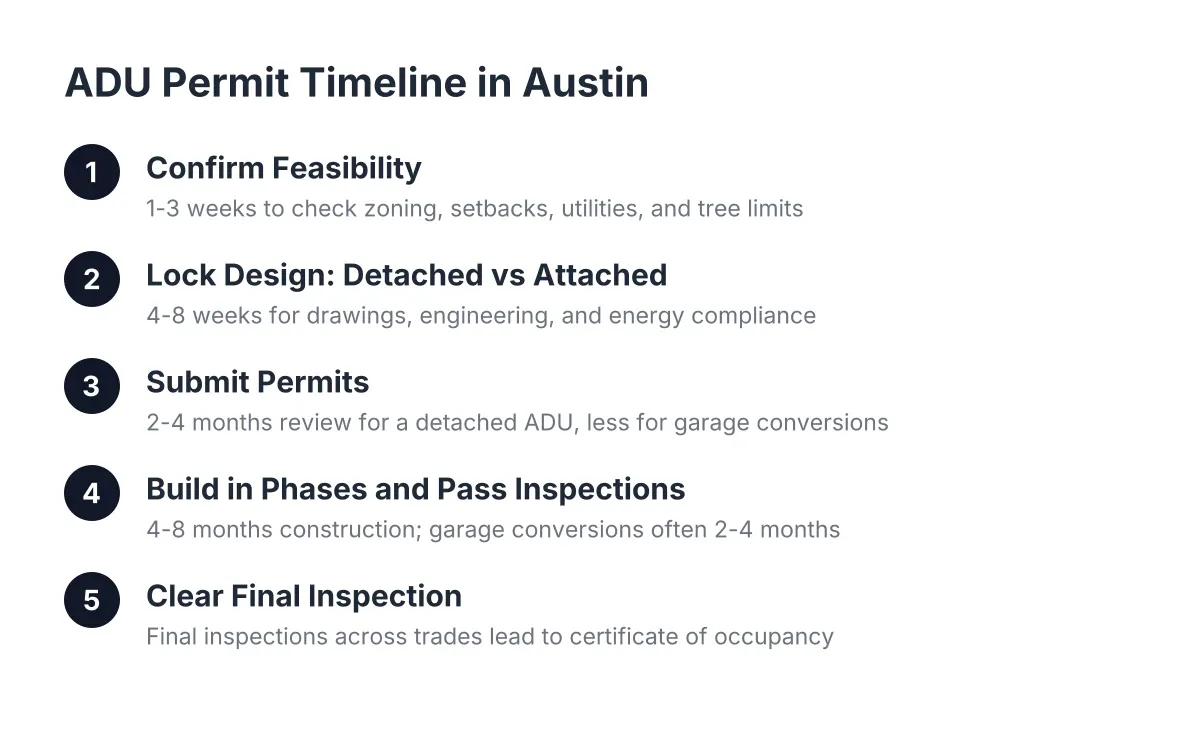
Every legal ADU in Austin needs a building permit, and a garage conversion needs one too, even though the structure already exists. The permit process generally involves a site plan showing setbacks and impervious cover, architectural drawings, energy code compliance, and trade permits for plumbing, electrical, and mechanical work. Review timelines vary with the city's backlog, so build schedule cushion into any plan that has a hard deadline, like a listing date.
Skipping the permit is the expensive shortcut. An unpermitted garage conversion shows up in the seller's disclosure, spooks buyers' lenders, and often appraises as a garage, not as living space. We see this most often when a seller converted a garage years ago for family use and now wants credit for the square footage at sale. Without permits, that credit usually is not there, and retroactive permitting means opening walls for inspection.
What an ADU Costs in Austin
ADU construction cost depends mostly on type, size, and site conditions, and the ranges are wide. As an illustrative estimate, a detached new-build ADU in the Austin metro commonly runs from about $150,000 to $350,000 or more all-in, depending on size, finishes, and how far utilities have to travel. That figure covers design, permits, sitework, construction, and utility connections, not just the structure.
Garage conversion cost runs meaningfully lower because the shell exists. As a rough estimate, converting a standard two-car garage to a studio or one-bedroom unit in Austin often lands between $60,000 and $150,000, driven by how much plumbing has to move and whether the slab, roof, and framing are sound. The cheapest way to convert a garage to living space is to keep the wet wall, meaning the kitchen and bathroom, on the side closest to the house's existing plumbing, keep the footprint as-is, and choose durable mid-grade finishes instead of custom work.
Be skeptical of any ADU construction cost calculator that spits out a single number for your address. Online calculators cannot see your tree canopy, your sewer line depth, your panel capacity, or your lot's impervious cover math, and in Austin those four items swing budgets by tens of thousands of dollars. Use a calculator to set a rough bracket, then get a walkthrough and a written scope before you commit to anything. Site conditions like sloped lots, aging electrical panels, or a slab that was never built to habitable standards are exactly the scenarios where a professional assessment pays for itself.
For a full line-item breakdown, we cover the numbers in depth in our separate guide to ADU construction costs. The short version: utilities, foundations, and permitting are the budget items that surprise people; cabinets and flooring are not.
Rental Income: The Honest Math in 2026
An ADU can generate real monthly income, but the Austin rental market in 2026 demands honest underwriting, not 2021 assumptions. According to Apartment List, average rent for a two-bedroom apartment in the Austin area peaked at $1,725 in August 2022 and fell to $1,382 by October 2025, a 19.9 percent decline, while vacancy rose from 3.96 percent to 9.71 percent. Translation: Austin has more rental supply than it did during the boom, and ADU rents softened along with everything else.
That does not make the income case dead; it makes it specific. ADUs compete on things apartments cannot offer: a private yard entrance, no shared walls, and a neighborhood address in places like Zilker or Travis Heights where small rentals are scarce. Short-term and medium-term rentals, such as travel nurses and corporate stays, often outperform long-term leases for well-located units, though the City of Austin licenses short-term rentals and the rules deserve a close read before you underwrite nightly rates.
Suppose a homeowner in East Austin builds a 650-square-foot detached one-bedroom for an estimated $220,000 all-in. If it rents long-term at around $1,400 to $1,600 a month in the current market, gross income covers roughly $17,000 to $19,000 a year before taxes, insurance, and maintenance. In that scenario the unit is not a fast payback machine; it is a durable income stream plus permanent square footage that transfers to the next owner. Run your numbers on today's rents, not on a listing agent's optimism or a 2021 comp.
How an ADU Affects Property Value and Your Sale
A permitted, well-built ADU adds appraisable square footage and broadens your buyer pool, but it does not return dollar-for-dollar on every lot. According to Redfin data, the median sale price in the Austin market reached $476,800 in Q3 2025, up 3.4 percent year over year, and in a market at that price point, a legal second unit is a genuine differentiator. Buyers see a mortgage helper, a home office, or a place for a parent, and that flexibility shows up in offers.
However, three caveats keep the picture honest. First, appraisers value ADU square footage lower than main-house square footage in many neighborhoods, so a $250,000 build rarely appraises for $250,000 of added value the day it finishes. Second, overbuilding for the street is a real risk; a luxury casita behind a modest home in Pflugerville prices the property out of its own comps. Third, if you are selling within a year, starting a ground-up ADU almost never makes sense. Pre-listing prep money is better spent on inspection repair items, paint, flooring, and the kitchen, where the payback window is measured in weeks, not years.
Where the sell-ready math does work is an existing unpermitted or half-finished conversion. Say you are preparing to list a Hyde Park home with a garage apartment the previous owner built without permits. Legalizing it, or at minimum scoping and disclosing its condition accurately, protects the sale from a failed appraisal or a renegotiation after the buyer's inspection. That is a managed project with a defined scope, not a construction adventure, and it belongs on the same punch list as the rest of your pre-listing repairs.
Is an ADU the Right Move for Your Property?
Whether an ADU makes sense comes down to your timeline, your lot, and your goal. It is the right move when you plan to hold the home for years, your lot clears the zoning and impervious cover math, and you want income or multigenerational space more than you want a bigger primary house. It is the wrong move when you are listing soon, your lot is tight or tree-covered, or a garage conversion would delete the parking your neighborhood expects.
A practical way to evaluate feasibility, in order:
- Check the lot. Confirm zoning, deed restrictions, HOA rules, impervious cover headroom, and protected trees before you sketch anything.
- Pick the type. Detached for income and privacy, attached or garage conversion for budget and family use.
- Price the utilities early. Sewer tie-in distance and electrical panel capacity are the two costs that blow up budgets; get them scoped first.
- Underwrite with 2026 rents. Use current comparable rentals in your neighborhood, not peak-market numbers.
- Match the build to the exit. Holding ten years justifies more spend than selling in two; if you are selling in one, redirect the budget to sell-ready prep.
For an Austin homeowner in 2026, an ADU is a legal second home on your lot that can house family, earn rent, and add lasting value, provided the zoning works, the budget is honest, and the permits are real. The feasibility answer lives in your specific lot's setbacks, trees, and utility runs, which is why the first real step is a walkthrough and a written scope, not a floor plan you fell in love with online. Whether you build one to hold or inherit one when you buy a home with a casita already in the backyard, understanding the rules and the real costs is what separates an asset from a liability across the Austin metro, from Westlake to Hutto.
If you need pre-listing home renovation, Lujo Realty can help.
Prefer to talk it through? Call Lujo Realty — a quick call is usually the fastest way to get a straight answer for your situation.